

Pastry Chef Attempts to Make Gourmet Pop Rocks | Gourmet Makes | Bon Appétit
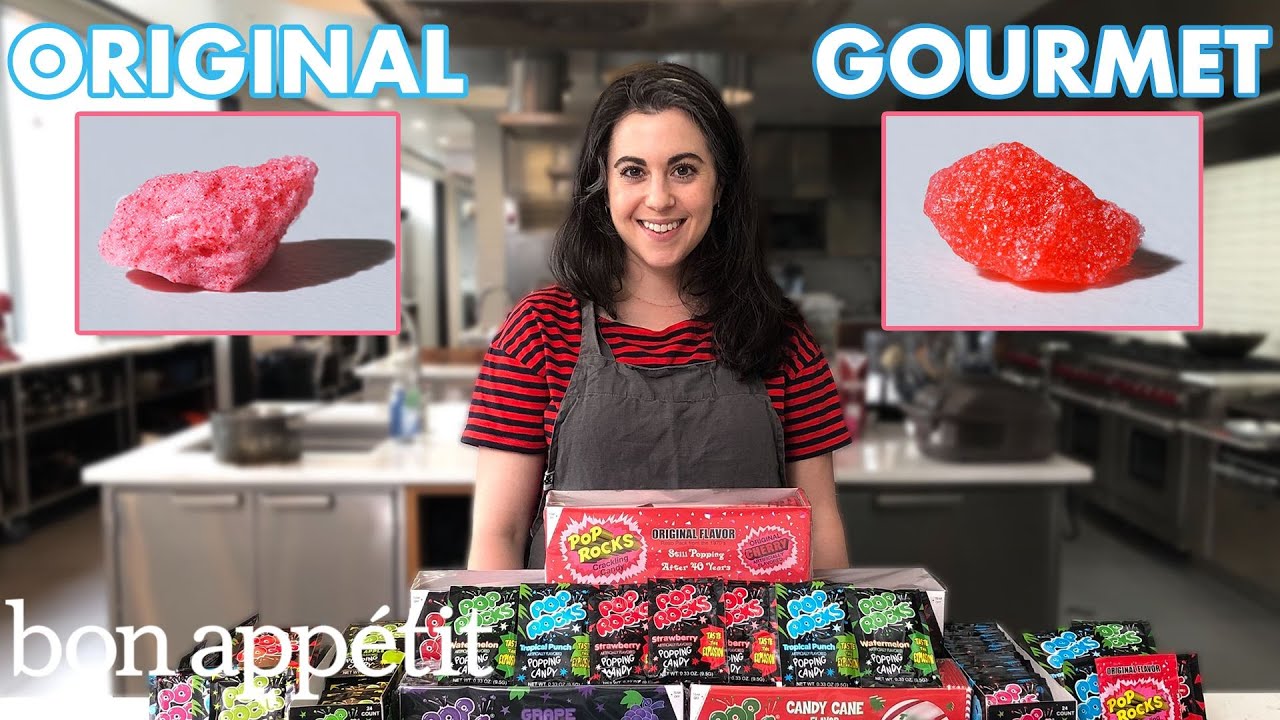

A cult candy from the 1970s gets the gourmet treatment inside the Bon Appétit Test Kitchen.
Pop Rocks have been popping in kids’ mouths since the 1970s, but nobody’s ever accused them of being sophisticated. That’s the challenge pastry chef Claire Saffitz takes on in this installment of Bon Appétit’s “Gourmet Makes,” the YouTube series where she reverse-engineers junk food classics from scratch and tries to make them taste like they belong in a real kitchen instead of a gas station checkout line.
- Commercial Pop Rocks are made industrially by infusing hard candy syrup with high-pressure carbon dioxide gas before it cools — a process no home or test-kitchen setup can replicate.
- Without factory equipment, Claire experiments with citric acid and baking soda mixed into hard-crack sugar bases to try to fake the same crackling, popping sensation.
- She eventually pushes past that combination to isomalt, a heat- and pressure-resistant sugar substitute, using a pressure cooker to chase the real popping effect.
The Chemistry Nobody Warned Her About
The actual manufacturing process behind Pop Rocks is almost aggressively industrial: hot candy syrup gets shot full of pressurized CO2 gas, then cooled while still under pressure so the gas stays trapped in tiny bubbles inside the hardened candy. Bite into it, and those bubbles rupture, releasing the gas as the crackle and pop that made the candy a novelty-aisle staple in the first place.
Claire doesn’t have a CO2 injection rig sitting around the Bon Appétit Test Kitchen, so she starts where most home cooks would: citric acid and baking soda, the same acid-base reaction that makes bath bombs fizz, folded into a hard-crack sugar syrup. It’s the logical first move, and it’s also where the episode’s real tension lives, because logical doesn’t mean it works.
Trial, Error, and the Isomalt Pivot
After the citric acid and baking soda approach falls short of the sharp, sustained fizz she’s after, Claire pivots to isomalt — a sugar substitute that holds up under high heat and pressure far better than standard granulated sugar. Paired with a pressure cooker, it becomes her workaround for mimicking an industrial gas-infusion process on a countertop budget.
Carbonation made solid — that’s the whole trick she’s chasing.
It’s the same trial-and-error rhythm that’s made “Gourmet Makes” a hit in the first place: watching a trained pastry chef get humbled by candy that costs less than a dollar a pack, then grind through the science until something clicks. Viewers who’ve followed her through past episodes know the show runs on that exact tension, the same way other creators on YouTube have built followings by pushing an oddball premise as far as it’ll go — see the sheer commitment behind something like World’s Largest Challenge! or the grind chronicled in Turning $0.01 Into a House in 1 Week: Days 7-28.
Getting the Flavor to Match the Snap
Once the pop itself is dialed in, Claire turns to flavor, working in natural flavorings including strawberry, lemon, and mint to move the candy away from the artificial-tasting profile of the original. She also builds out a chocolate-flavored version, which she considers one of the episode’s clear wins — proof that the popping texture can carry a more complex flavor than the shelf version ever attempted.
The finished batch lands with the Bon Appétit team, who treat it less like a science-fair project and more like an actual candy worth eating twice. That reaction is the real payoff of the episode: a two-dollar novelty candy getting taken seriously enough that a trained pastry chef spends an entire shoot troubleshooting sugar chemistry to get it right.









Secrets Beyonce Revealed In Her Lemonade Lyrics
Coast Guard Dude Surfs a Narco-Sub Packed With Cocaine
Every Car in Fast & Furious RANKED | WheelHouse
World’s Longest T-Shirt Launch | OT 33
Skip Bayless: Kyler Murray showed he’s a ‘special playmaker’ in preseason debut | NFL | UNDISPUTED