

The Real Stories Behind 20 Iconic Pictures

Twenty photographs changed how the world remembers its own history — and almost none of the popular captions tell the full story.
TheThings Celebrity’s video “The Real Stories Behind 20 Iconic Pictures” runs through the images that ended up on magazine covers, history textbooks, and protest signs, then digs into what was actually happening outside the frame. Some of the details are well known — a napalm strike, a burning monk, a flag on a hill in the Pacific. Others, like the identity of the man who spent decades as “just” the Afghan Girl, took years to surface at all.
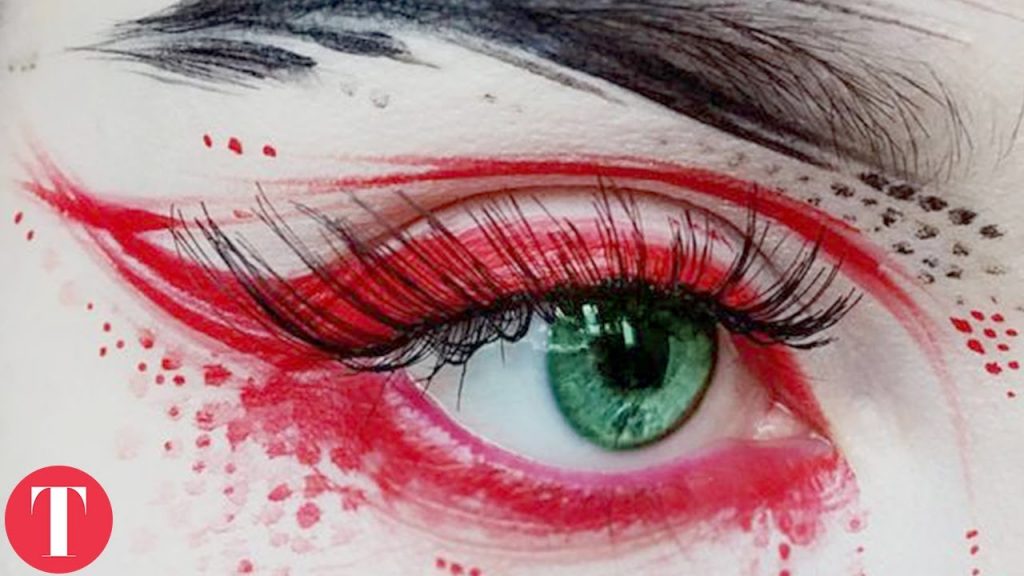
- Steve McCurry’s 1984 portrait of a green-eyed girl in a Pakistani refugee camp became a global symbol of displacement during the Soviet-Afghan War — the subject was later identified as Sharbat Gula.
- The “Tank Man” photograph from the June 1989 Tiananmen Square protests shows an unidentified man standing alone in front of a column of military tanks in Beijing; he has never been publicly identified.
- Vietnam War photography produced two of the list’s most disturbing entries — Eddie Adams’ 1968 “Saigon Execution” and Nick Ut’s 1972 “Napalm Girl” — both of which turned battlefield violence into anti-war symbols almost overnight.
The Afghan Girl’s Hidden Identity
McCurry shot the photo in 1984 for National Geographic, capturing a young girl with piercing green eyes inside a refugee camp housing Afghans who had fled the Soviet-Afghan War. The magazine ran the image without a name attached, and for years the “Afghan Girl” existed purely as an icon of wartime displacement rather than a person. It wasn’t until she was tracked down and identified as Sharbat Gula that the photograph got a name to go with the face that had already been reproduced on posters, magazine racks, and dorm-room walls worldwide.
Tank Man and the Tiananmen Standoff
The video’s account of the Tiananmen image centers on how little is actually confirmed about it. In June 1989, during the crackdown on protests in Beijing’s Tiananmen Square, a lone man stepped in front of a line of tanks moving down Chang’an Avenue. Photographers captured the standoff from nearby hotel balconies, but the man’s name, his fate, and even his exact motive were never established. A related image from the same protests, taken by Jeff Widener, shows a man standing before a runaway train cart amid the same crowd of demonstrators.
A column of tanks stopped for one unidentified man in Tiananmen Square in June 1989 — and no one has ever confirmed who he was.
War, Protest, and the Camera’s Eye
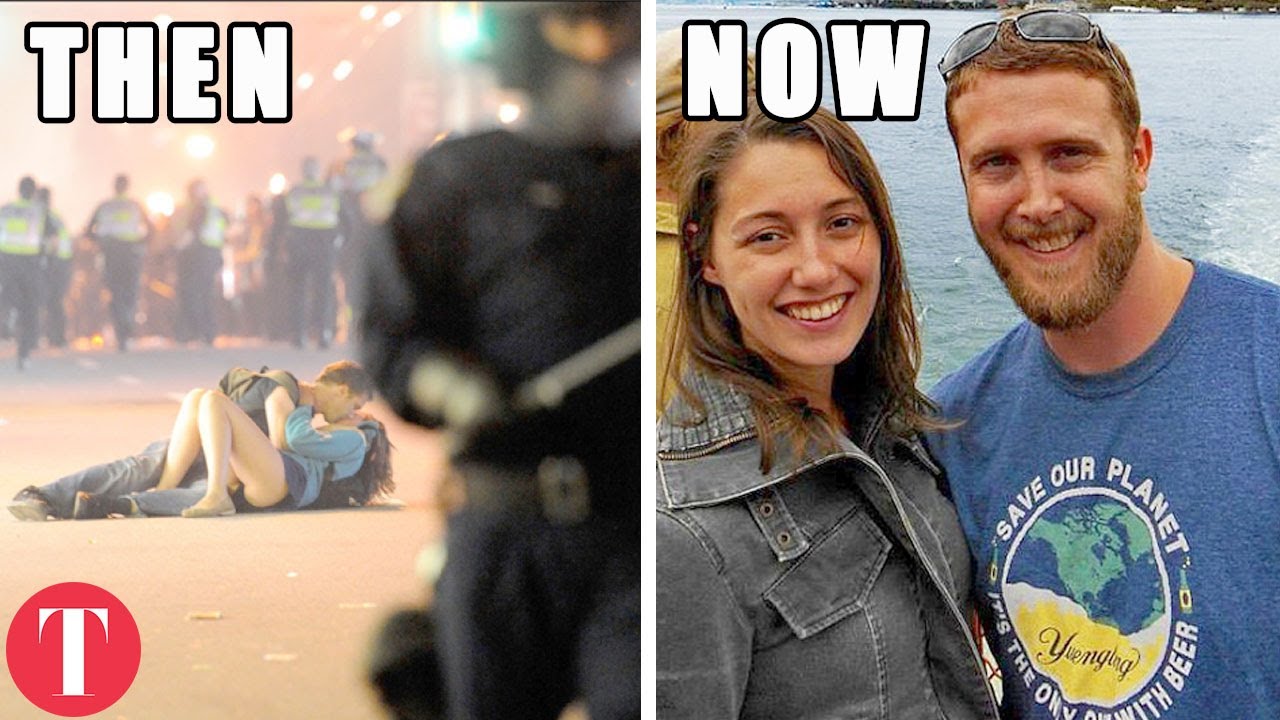
Several of the video’s entries come out of Vietnam. Eddie Adams’ 1968 photo of South Vietnamese General Nguyen Ngoc Loan executing a Viet Cong prisoner became shorthand for the war’s brutality the moment it hit newspapers. Four years later, Nick Ut’s image of a young girl running from a napalm strike carried the same weight in the opposite direction — proof of what the bombing campaigns were doing to civilians. Malcolm Browne’s photograph of the monk Thich Quang Duc setting himself on fire in protest of the South Vietnamese government’s treatment of Buddhists belongs in the same category: a single frame doing the work of a thousand headlines. These images sit alongside Joe Rosenthal’s flag-raising shot at Iwo Jima and Alfred Eisenstaedt’s 1945 V-J Day kiss in Times Square as the moments that defined how wartime and its aftermath actually looked on film, the kind of viral photographs the internet just wouldn’t let go of decades before the internet existed.
From Earth to Einstein
Not every entry on the list is grim. Arthur Sasse’s 1951 shot of Albert Einstein sticking out his tongue on his 72nd birthday turned a Nobel laureate into as much a celebrity as the events he studied, and it remains one of the most reproduced images of a scientist ever taken. The video also covers the Apollo program’s contributions — the 1968 “Earthrise” photo from William Anders and the 1972 “Blue Marble” shot from Apollo 17 — plus Dorothea Lange’s 1936 “Migrant Mother” portrait of Florence Owens Thompson, Robert Doisneau’s 1950 Paris street kiss, and Margaret Bourke-White’s 1946 photograph of Mahatma Gandhi at his spinning wheel.
The countdown closes on Leonardo da Vinci’s “The Last Supper,” included not as a photograph but as the painting that arguably started the whole idea of a single image carrying centuries of meaning — proof that the list’s real subject isn’t cameras at all, it’s the handful of pictures that refuse to fade no matter how many decades pass.







The Real Reason Cardi B And Offset Broke Up
Don’t Ignore THIS Early Warning Sign – MUSCLE LOSS!!
Actors Who Should Have Been Fired From Their Roles
The Call | Season 2022 Cinematic – League of Legends (ft. 2WEI, Louis Leibfried, and Edda Hayes)
Amendola Gets Burned By Ex Olivia Culpo And His Bikini Mistress