

Why Apollo Astronauts Trained at a Nuclear Test Site
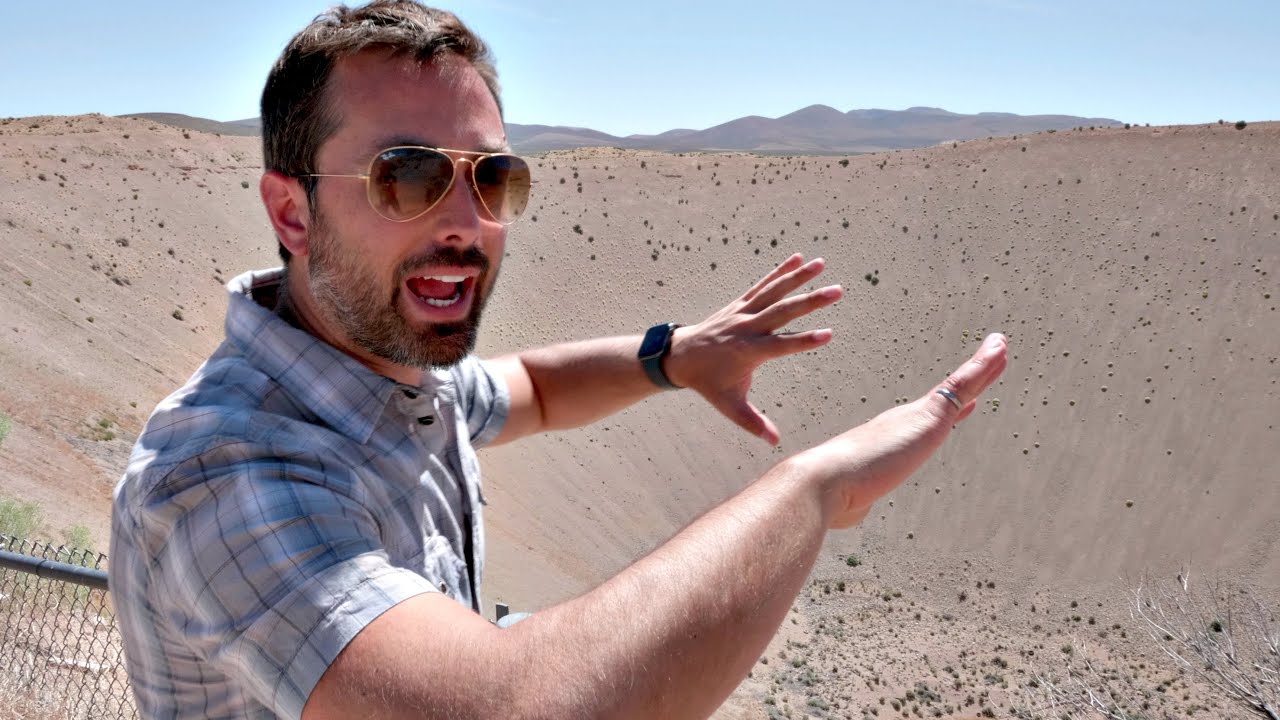

Before astronauts walked on the moon, they walked through nuclear bomb craters in the Nevada desert.
Derek Muller’s Veritasium video “Why Apollo Astronauts Trained in Nuclear Bomb Craters” digs into a strange but essential chapter of the Apollo program: NASA sending its lunar crews to the Nevada Test Site to study holes blown into the ground by underground nuclear detonations. The reasoning wasn’t about radiation tolerance or survival training — it was geology. Scientists needed astronauts who could read a crater’s rock layers and rubble the way a field geologist reads a road cut, and nowhere on Earth offered a better analog for lunar impact sites than the blast craters at Yucca Flat.
- On February 16, 1965, Neil Armstrong, Buzz Aldrin, Dick Gordon, Dave Scott, and Rusty Schweickart completed a three-day field training mission in Nevada to study terrain resembling the lunar surface.
- Sedan Crater — 1,200 feet wide and 320 feet deep — was carved out on July 6, 1962, by a 100-kiloton underground nuclear detonation conducted under Project Plowshare.
- Astronauts from Apollo 14, Apollo 16, and Apollo 17 returned to train at Sedan and the nearby Schooner crater through late 1970 and 1971.
A Desert Classroom for Moonwalkers
The Apollo program’s geology training wasn’t optional theater. Armstrong, Aldrin, Gordon, Scott, and Schweickart’s three-day trip in February 1965 was designed to get astronauts comfortable identifying rock types, layering, and impact debris under real field conditions before anyone set foot on lunar soil. The Nevada Test Site — now called the Nevada National Security Site — gave NASA a landscape scarred by dozens of detonations, each one a rough stand-in for the kind of cratering the crews would eventually photograph and sample 240,000 miles from home.
Cracking the Meteorite Crater Debate
The deeper reason this training mattered goes back decades before Apollo, to a fight over Barringer Crater in Arizona. Mainstream geologists had long written it off as a volcanic feature, dismissing the meteorite-impact theory outright. What changed their minds wasn’t more digging at Barringer itself — it was studying underground nuclear test sites, where the shock pressures and energy levels turned out to closely mimic hypervelocity meteorite strikes rather than anything volcanic.
Researchers found shock-metamorphosed minerals and telltale structural signatures — overturned rim strata, distinct ejecta blankets — at nuclear blast sites that matched what they eventually confirmed at Barringer. That breakthrough didn’t just settle an old argument about one crater in Arizona; it gave NASA a validated blueprint for what an impact crater actually looks like up close, which is exactly the skill set Apollo crews needed before they went hunting for real ones on the moon.
Sedan Crater — 1,200 feet wide, 320 feet deep, carved by a 100-kiloton blast — became the closest thing on Earth to a training-ready lunar impact site.
Sedan Crater’s Starring Role
Of all the pockmarked ground at Yucca Flat, Sedan Crater did the heaviest lifting. Created on July 6, 1962, by a 100-kiloton underground detonation under Project Plowshare — the government’s since-abandoned push to find peaceful, industrial uses for nuclear explosives — Sedan left behind a depression 1,200 feet across and 320 feet deep. For NASA’s purposes, it was a near-perfect physical proxy: astronauts could walk its rim, trace its ejecta, sample its stratigraphic layers, and practice spotting impact-induced minerals in a setting that behaved geologically like a real impact crater rather than a man-made pit.
Training That Outlasted the Early Missions
This wasn’t a one-off exercise ahead of the first landing. Crews training for Apollo 14, Apollo 16, and Apollo 17 kept coming back to Nevada, running surface exercises at Sedan and the neighboring Schooner crater as late as 1970 and 1971. By the time Apollo 17’s crew wrapped their own desert fieldwork, the program had spent roughly six years sending astronauts into nuclear bomb craters to rehearse the exact skills — crater mapping, sample selection, terrain description — that would define their actual moonwalks.
What’s easy to miss watching Apollo footage decades later is how much of the astronauts’ confident crater-side chatter on the moon was rehearsed, almost word for word, on the rim of a hole blown open by a 100-kiloton bomb in the Nevada desert nine years earlier.









Expectation vs. Reality: 10 Biggest Pinterest FAILS
Screening top soil
10 Things Girls REALLY Want From Guys
2020 Chevrolet Corvette Stingray – First Look
10 Flight Attendants Who Dress BETTER Than You