

 InfoSearched
Somewhere out there, seven strangers share your exact face.
That’s the number folklore keeps repeating, and in 2015 a handful of ordinary people decided to actually go find them. What started as a 28-day dare between three friends in Dublin turned into a website, a viral flight-seat mix-up over a red beard, and a peer-reviewed statistic putting the odds at less than one in a trillion. This is how “Twin Strangers” went from a personal bet to a worldwide obsession.
- Irish TV presenter Niamh Geaney, 26, launched the Twin Strangers challenge in April 2015 with friends Terence Manzanga and Harry English, testing the old claim that everyone has roughly seven doppelgängers.
- Geaney met her closest match, Karen Branigan, just an hour away in Dublin, then traveled to Genoa, Italy, in June 2015 to meet a second lookalike, Luisa Guizzardi.
- University of Adelaide researcher Teghan Lucas found the odds of two unrelated people sharing eight identical facial metrics are less than one in a trillion.
The 28-Day Bet That Started It All
Geaney, Manzanga and English set themselves a simple challenge: 28 days to find someone completely unrelated who looked enough like them to pass as a twin. They put out a call for photo submissions from strangers around the world and sorted through the responses looking for shared hair color, eye shape and bone structure rather than a passing resemblance.
Geaney’s search turned up two serious contenders. The first, Karen Branigan, lived barely an hour from her in Dublin. When the two met and styled themselves identically for the cameras, the resemblance was close enough that Geaney said afterward, “Karen probably looks more like me than my sisters do.”
“Karen probably looks more like me than my sisters do.”
Crossing Borders for a Second Match
Geaney wasn’t done. By June 2015 she’d traveled to Genoa, Italy, to meet Luisa Guizzardi, a second near-identical match turned up through the same crowdsourced search. The trip made headlines again, reinforcing the idea that a genuine facial double could be sitting in an entirely different country and language, waiting to be found through nothing more than a photo and a hunch.
The project’s reach kept expanding as more matches went public — Swedish user Sara and Irish user Shannon, and American lookalikes Ambra and Jennifer, both pairs meeting for the first time after finding each other through the same crowdsourced effort. Each meetup added to a growing archive of proof that the “seven strangers” folklore wasn’t just a party trick.
From a Viral Video to TwinStrangers.net
Once footage of Geaney’s search took off online, she and her friends built it into something more permanent: TwinStrangers.net, a site where users submit facial photos and select specific facial metrics to search for matches worldwide. It turned a one-off dare into an ongoing matching service, and it’s the same infrastructure that surfaced the Sara-Shannon and Ambra-Jennifer pairings.
The mechanics matter here — this wasn’t a beauty-pageant style vote on look-alikes, but a metric-driven search, the same logic that researchers would later use to quantify just how rare these matches really are. For readers who enjoy tracking uncanny resemblances in a more famous context, celebrity doppelgängers who look freakishly alike shows the same phenomenon playing out among stars rather than strangers on a website.
Real-World Coincidences Outran the Website
While Geaney’s project was deliberately searching for matches, plenty of twin strangers found each other completely by accident. In October 2015, exchange students Ciara Murphy of Ireland and Cordelia Roberts of the UK discovered their classmates had been calling them “twins” after they both coincidentally enrolled at the University of Bremen in Germany.
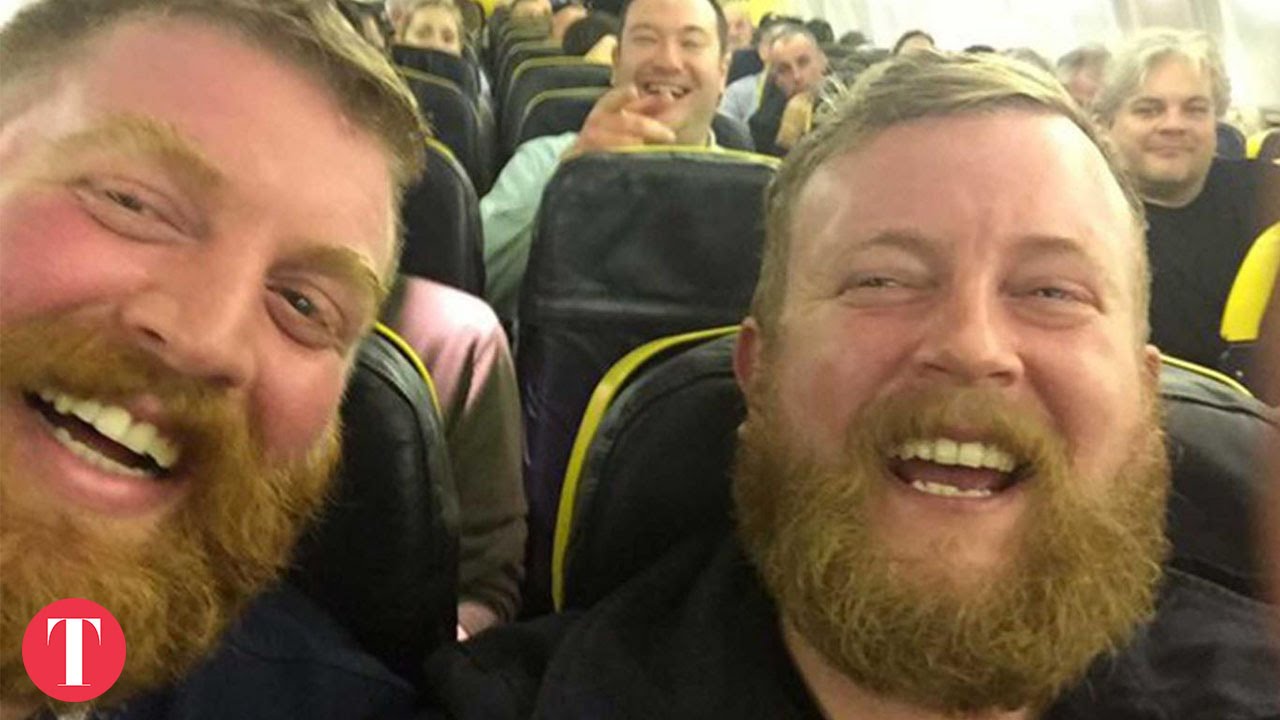
Days later, a different encounter went massively viral for an entirely different reason. Photographer Neil Douglas boarded a Ryanair flight to Galway and found a bearded stranger, Robert Stirling, already sitting in his assigned seat — the two men sharing an almost identical red beard and face. The photo spread fast, landing squarely in the same wave of attention the Twin Strangers project had already built.
The Math Behind the Miracle
None of this happened in a vacuum of pure coincidence — there’s real science backing up just how strange these matches are. University of Adelaide medical researcher Teghan Lucas evaluated a comprehensive set of facial dimensions and concluded that the odds of two unrelated people sharing eight identical metric facial traits are less than one in a trillion, which makes every one of these meetups statistically closer to a lottery win than a common occurrence.
That number is what turned Twin Strangers from a fun internet story into something researchers took seriously, and it’s why Geaney’s site kept adding matching pairs throughout 2015 rather than being a one-time viral fluke.

What Really Happens Behind The Scenes At The World Cup
Gregory Peck’s Grandson Has Grown Up To Be Gorgeous
The Most Controversial SNL Sketches Of All Time
The Truth About El Chapo’s Stunning Wife
Actors Who Hated Kissing Each Other On Screen