

 InfoSearched
A century of physics textbooks may have gotten one of the most basic questions in electrical engineering wrong.
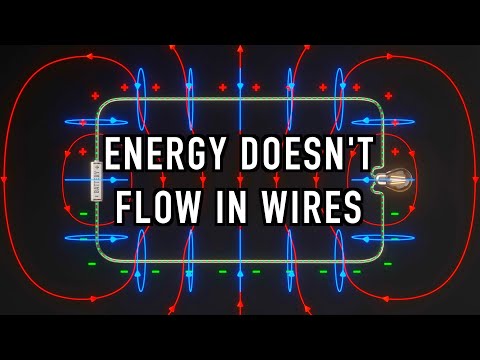
Derek Muller’s Veritasium published “The Biggest Misconception About Electricity” in November 2021, and it did something rare for a science channel: it made professional electrical engineers argue in the comments. Muller goes after the standard explanation of how a circuit works — electrons drifting from battery to bulb — and replaces it with an answer rooted in Maxwell’s equations and the Poynting vector.
- Muller argues energy doesn’t travel through the copper wire itself but through the electromagnetic field surrounding it, entering components directly from free space.
- His thought experiment: a battery, switch, and bulb spaced 1 meter apart, wired with two conductors stretching 300,000 kilometers into space and back — a round trip of one light-second.
- Veritasium’s answer to “how fast does the bulb turn on” is 1/c, roughly 3.33 nanoseconds — not the 1 or 2 seconds a signal traveling the wire loop would suggest.
The Thought Experiment That Broke the Comments Section
The setup is almost cartoonish in scale. Take an ideal circuit — a battery, a switch, and a lightbulb, each just 1 meter apart from the others. Now run the two connecting wires 300,000 kilometers away into deep space and back, so the total wire length is around 600,000 kilometers, exactly one light-second of travel distance. Close the switch. When does the bulb light up?
Muller offers five options: 1 second, 2 seconds, half a second, 1/c, or none of the above. The intuitive answer — the one most people trained on “current flows through the wire” logic would pick — is somewhere around 1 or 2 seconds, however long it takes a signal to make the round trip through those gigantic loops. That answer is wrong, according to Veritasium’s explanation.
Single Conductor Superiority Over Loops
Muller’s case rests on the idea that the bulb doesn’t need current to complete the entire 600,000-kilometer loop to turn on. Because the battery, switch, and bulb sit just 1 meter apart, the electromagnetic field generated when the switch closes crosses that 1-meter gap at the speed of light, inducing a current in the bulb almost instantly — in about 3.33 nanoseconds, or 1/c. The signal traveling down the enormous wire loop is irrelevant to that initial jolt of energy; it’s the field jumping the short gap between components that lights the bulb.
Electrons themselves only drift at millimeters per second — the energy that lights the bulb isn’t riding on them at all.
That’s the detail that undercuts the classic textbook picture. If energy really depended on electrons physically migrating from the battery’s terminal to the bulb’s filament, the wait would be absurd given how slowly electrons actually drift inside a copper wire. Muller’s framing instead puts the electromagnetic field, not the electron stream, in the driver’s seat.
Maxwell’s Equations Versus the Textbook Model
The video leans on Maxwell’s equations and the Poynting vector — the standard tool physicists use to describe the direction and magnitude of energy flow in an electromagnetic field — to argue that energy in any circuit travels through the space surrounding the conductors, not through the conductors themselves. Wires, in this telling, function more like guides that shape and direct the field than pipes that carry the energy internally.
That’s a significant departure from how circuits are typically taught, where current is treated as the thing “delivering” energy along the wire. Muller’s argument doesn’t say current or resistance stop mattering — it says the delivery mechanism people picture is backwards.
A Debate That Spilled Into Transmission Line Theory
The video’s release triggered immediate, detailed pushback and discussion across physics and electrical engineering circles. Much of it centered on transmission line theory, transient wave fronts, mutual capacitance between the two long wires, and — perhaps most contentious — what actually counts as the bulb “turning on.” Some engineers argued that a real bulb wouldn’t visibly glow from a few nanoseconds of induced current, that the practical threshold for “on” depends on the filament and circuit’s actual electrical characteristics, and that transmission-line effects in a real 600,000-kilometer wire pair would complicate the clean 1/c answer.
None of that dulled the reach of the video. It became one of the more argued-over science uploads of the year precisely because the standard classroom explanation is so deeply ingrained — and because Muller was directly challenging something nearly every viewer had been taught as settled fact.
Actual Proofs of Thought Experiments
Strip away the light-second-long wires and the core claim is simple: in an ideal circuit, the energy that reaches the bulb arrives via the field crossing the small physical gap between components, at the speed of light, not by riding electrons through the wire. The giant wire loop is a deliberately extreme way of separating those two mechanisms so the difference becomes measurable in principle — 3.33 nanoseconds versus a full second is impossible to confuse once you frame it that way.
Whether or not every electrical engineer accepts Muller’s framing of “the bulb turns on,” the debate itself is the story — a single YouTube upload got working engineers relitigating Maxwell’s equations in public, which is a rare thing for a video with a lightbulb and a battery on the thumbnail.









Real Housewives Who Need To Realize They Aren’t Famous Anymore
THE ADDAMS FAMILY | Official Trailer | MGM
Gordon Ramsay Makes SPAM Scrambled Eggs in Hawaii | Scrambled
Stars Who Are Jehovah’s Witnesses
10 Celeb Doppelgangers That Had Us Fooled