

Fiber vs. Copper; What do we really need?
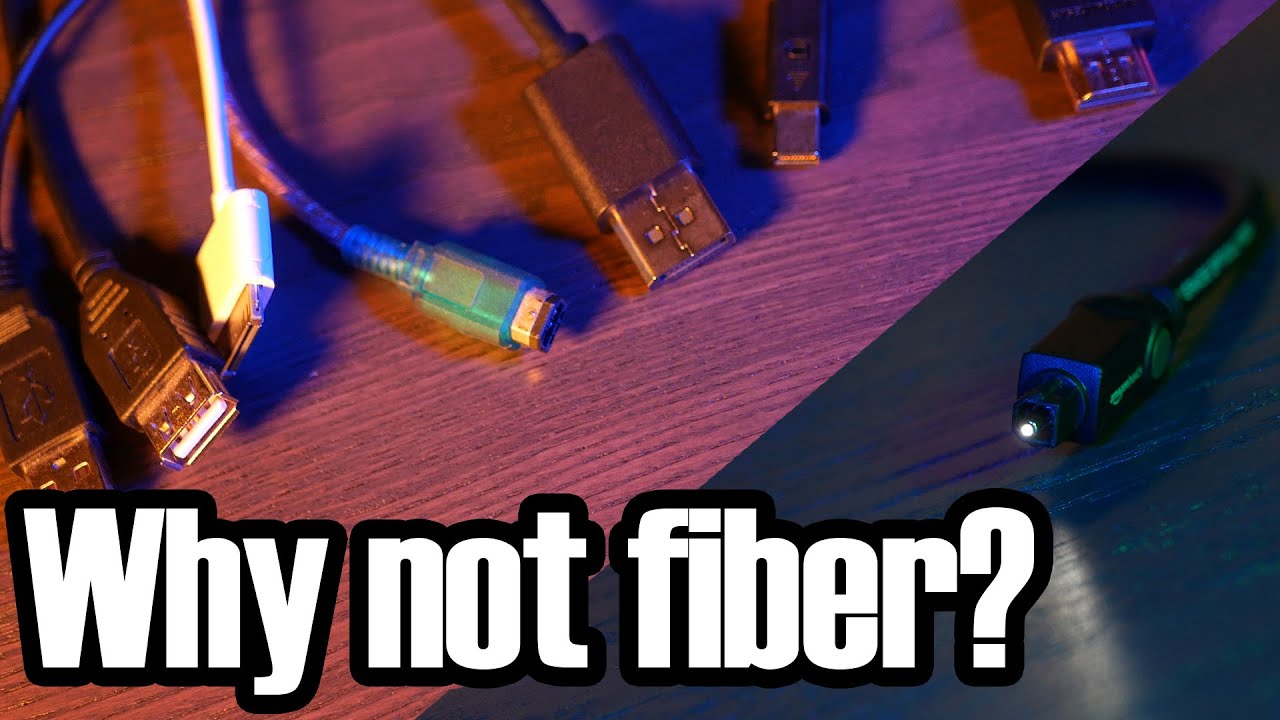

Two cables, one house, and a debate that’s been running since the 1980s.
Alec Watson, the mind behind the YouTube channel Technology Connections, spends the better part of a video breaking down why the wire running into your modem still isn’t glass, even though glass has been technically superior for decades. His video, “Fiber vs. Copper; What do we really need?”, walks through the physics of both mediums and lands on a practical answer: it depends what you’re trying to do with the connection.
- Copper (coax, Cat6 twisted-pair) moves data as electrical current and tops out around 100 meters (roughly 330 feet) before signal degradation forces a repeater.
- Fiber moves data as pulses of light via total internal reflection, running 25 to 40+ kilometers unassisted on single-mode strands with speeds well beyond 10 Gbps.
- Copper still wins on one thing glass can’t do at all: Power over Ethernet, sending electricity down the same line as the data.
Signal Transmission Mechanics Explained
Watson’s starting point is the basic physics most people never think about. Copper cabling, whether it’s the coax feeding a cable modem or the Cat6 running to a switch, carries information as electrical current riding the wire. Fiber optic cable does something stranger: it fires rapid pulses of light through a glass or plastic core, bouncing the beam down the strand through total internal reflection until it reaches a receiver on the other end.
That distinction isn’t academic. Electrical signals lose strength as they travel and pick up noise from anything nearby with a magnetic field. Light doesn’t have that problem in the same way, which is the whole reason fiber became the backbone of long-haul telecom networks decades before it ever showed up in a residential install.
The Bandwidth Gap
The video lays out just how lopsided the ceiling is between the two mediums. Fiber’s bandwidth scales toward terabits per second in theory, and consumer and enterprise deployments already routinely clear 10 Gbps with symmetrical upload and download, something DSL and most cable-modem setups still can’t match. Copper’s electrical signaling simply runs into a bandwidth wall that fiber doesn’t have.
Light doesn’t attenuate the way electricity does — that’s the whole ballgame.
That gap matters more every year as households run more devices at once. Anyone downloading a large patch or a new trailer, like the gameplay reveal for Destiny 2: The Witch Queen, while someone else streams video in another room is leaning on exactly the kind of headroom fiber provides and copper struggles to.
Distance, Interference, and Security
Twisted-pair copper’s 100-meter ceiling is why every wiring closet in an office building exists roughly where it does — you physically can’t run Ethernet much farther without a repeater. Fiber shrugs that off, covering tens of kilometers without assistance. Watson also flags a security angle that rarely comes up in consumer conversations: copper radiates a detectable electromagnetic signal that can be tapped, while fiber doesn’t bleed signal outside the strand, making it effectively immune to that kind of eavesdropping.
Copper Leads the Last Mile
If fiber is faster, more secure, and travels farther, the obvious question is why copper is still what’s bolted to the side of most houses. Watson’s answer comes down to money and legacy. Telecom backbones have run on fiber for years, but the “last mile” connecting that backbone to an individual home is still copper almost everywhere, because ripping out and replacing entrenched infrastructure is expensive, field terminations are simpler with copper, and the transceiver hardware on each end costs less.
Then there’s the trick copper can pull that fiber can’t touch at all: Power over Ethernet. A copper line can carry electrical current alongside its data signal, which is why security cameras, VoIP phones, and wireless access points can run off a single cable with no separate power brick. Glass strands carry light, not current, so anything relying on PoE still needs copper somewhere in the chain — which is a big part of why indoor networking hasn’t gone all-glass even as the outside world races toward fiber.
That trade-off is really the whole video in miniature: fiber wins on every raw performance number, but copper’s ability to also deliver power, plus its head start already in the walls, is what keeps it wired into homes for now.









Borderlands 3 – Amara Character Trailer: “Looking for a Fight”
Why NASA hasn’t gone back to the Moon
10 Most INNOVATIVE BEAUTY PRODUCTS Ever
MAGIC LURE CATCHES BIG BASS!!! (Summer Jon Boat Fishing)
10 Things Guys WISH Girls Knew