

BUGATTI – Everything You Need to Know | Up to Speed
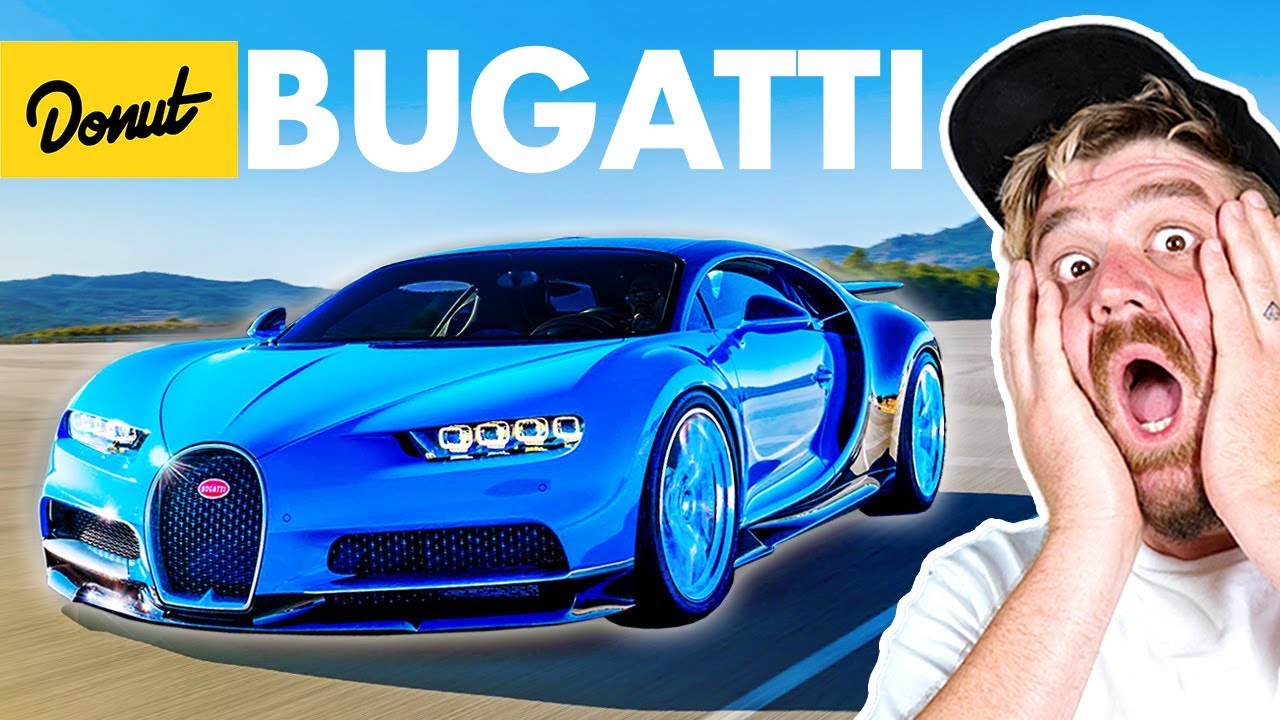

Bugatti’s story didn’t start with the Veyron — it started with a teenage engineer in Milan and a hollow front axle that changed racing forever.
Everyone knows the Veyron broke 250 miles per hour and the Chiron pushed past that with 1,500 horsepower. What gets skipped is the century in between — the bankruptcies, the death of a founder’s son, and a decade-long shutdown that nearly buried the name for good. Donut Media’s James Pumphrey walks through all of it in this episode of “Up to Speed,” tracing Bugatti from a 1909 workshop in Molsheim, France, to the quad-turbo monsters rolling out of Molsheim today.
- Ettore Bugatti’s Type 35, which debuted in 1924, used a hollow front axle and roller-bearing crankshaft to rack up more than 1,000 race victories, including five consecutive Targa Florio titles.
- Bugatti went dark after Ettore’s son Jean died in 1939 and World War II disrupted production; the original company was defunct by the time Ettore died in 1947.
- Volkswagen’s 1998 purchase, driven by Ferdinand Piëch’s demand for a 1,000-metric-horsepower, 400 km/h road car, produced the 2005 Veyron 16.4 and its 8.0-liter quad-turbo W16.
Ettore Bugatti’s Early Engineering
Ettore Bugatti was Italian by birth but built his legacy in eastern France, founding Automobiles E. Bugatti in Molsheim in 1909. From the start he chased a specific formula: strip weight out of everything, then chase performance and design in equal measure. His early Type 1 laid the groundwork for what would become the company’s signature — cars that looked like sculpture and ran like race machines.
The Type 35 Changes Grand Prix Racing
The car that made Bugatti’s name is the Type 35, which hit the grand prix circuit in 1924. Its hollow front axle shaved weight without sacrificing strength, and its roller-bearing crankshaft was mechanically ahead of almost everything else on the grid at the time. The results speak for themselves: over 1,000 race wins across its production run and five straight Targa Florio championships, a run of dominance few race cars in any era have matched.
Over 1,000 race victories and five consecutive Targa Florio titles — the Type 35 didn’t just compete, it ran the table.
Collapse, War, and Silence
Bugatti’s momentum stopped hard. Jean Bugatti, Ettore’s son and the man expected to carry the company forward, died in 1939. World War II gutted the Molsheim operation shortly after, and when Ettore himself died in 1947, the original Bugatti company had no path left — it was effectively defunct, its name dormant for decades.
Romano Artioli’s Revival and the EB110
Bugatti sat quiet until 1987, when Italian entrepreneur Romano Artioli relaunched the marque in Campogalliano, Italy. Artioli’s showpiece was the EB110, unveiled on September 15, 1991 — timed deliberately to Ettore Bugatti’s 110th birthday. The car packed a quad-turbocharged 3.5-liter V12, a carbon-fiber monocoque, and all-wheel drive, genuinely radical hardware for a supercar in 1991. It wasn’t enough to survive the economic downturn of the early ’90s, and the company filed for bankruptcy in 1995.
Volkswagen’s W16 Gamble
The name resurfaced for good in 1998, when Volkswagen Group acquired Bugatti under the direction of Ferdinand Piëch, who set an almost absurd target: a road car with 1,000 metric horsepower capable of clearing 400 km/h. That mandate produced the 2005 Veyron 16.4, built around an 8.0-liter quad-turbo W16 engine. Pumphrey traces the lineage from there to the 1,500-horsepower Chiron, launched in 2016, and the track-focused Divo, which arrived in 2018 stripped and sharpened for corners rather than straight-line top speed. Readers who enjoy this kind of long-form YouTube deep-dive have plenty of company — the same appetite that fuels stunt-driven series like World’s Largest Challenge! or marathon formats like 100 Hours In Minecraft Hardcore: Episode 1 is exactly why channels like Donut Media have built an audience around history explainers instead of just car reviews.
What Pumphrey’s episode makes clear is that the Divo wasn’t a detour from Bugatti’s ethos — it was the same instinct that built the Type 35, just aimed at a skidpad instead of the Targa Florio. Strip weight, chase an edge nobody else has, and let the lap times do the talking.








10 Awesome Celebs Who Went To Prom With Their Fans
Stranger Things’ Winona Ryder & David Harbour Answer the Web’s Most Searched Questions | WIRED
Draymond and KD Reveal What Really Happened with Warriors Fallout | FULL INTERVIEW (Chips)
Jessica Simpson Calls Out Natalie Portman For Shaming Her Bikini Pic
Borderlands 3 – Amara Character Trailer: “Looking for a Fight”