

What’s the Fastest Way to Travel in Minecraft 1.14?
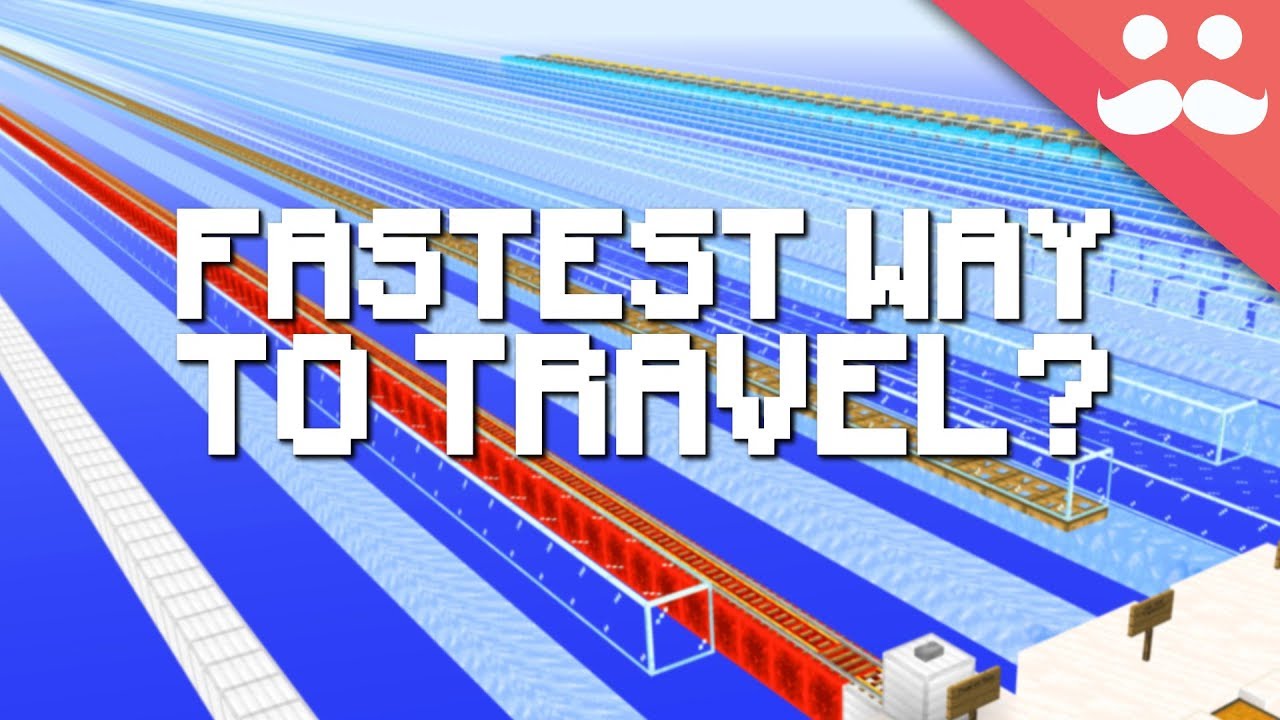

Minecraft’s Village & Pillage update didn’t just add cats and villagers trading — it quietly reshuffled the entire conversation about how fast a player can actually cross the map.
In “What’s the Fastest Way to Travel in Minecraft 1.14?”, posted August 2, 2019, Mumbo Jumbo runs the numbers on every real transit option available in Java Edition 1.14, from a plain sprint-jump to a boat screaming across Blue Ice at over 70 blocks a second. The video treats travel like an engineering problem, testing each method against the others and against the game’s strangest mechanic: the Nether’s 8:1 distance ratio.
- Minecarts are capped at 8 m/s, only marginally faster than sprint-jumping and well ahead of the 4.3 m/s base walking speed.
- Boats hit roughly 40 m/s on normal or packed ice, but Blue Ice pushes that ceiling to 72.73 m/s — nearly double.
- Routing a Blue Ice boat line through the Nether, where 1 block equals 8 Overworld blocks, produces an effective Overworld transit rate exceeding 580 blocks per second.
The Baseline Options
Mumbo starts with the methods every survival player already has access to. Walking clocks in at 4.3 m/s, horses improve on that but taper off over long hauls, and minecarts on a rail line max out at a hard-coded 8 m/s regardless of how the track is built. Sprint-jumping — repeatedly jumping while sprinting — edges out flat sprinting thanks to Minecraft’s movement quirks, but none of these come close to touching the endgame tools later in the video.
That gap is the whole point of the comparison. A minecart network takes real investment in rails and redstone boosters and still tops out at 8 m/s, which makes it a practical short-range solution rather than a long-distance answer.
Nether Logic and the 8:1 Shortcut
The video’s central mechanic is what Mumbo calls “Nether logic”: for every block traveled in the Nether, a player covers 8 blocks in the Overworld. Build a portal at 0,0 in the Overworld and a second one at 0,800, and the corresponding Nether portals only need to sit 100 blocks apart to link them correctly — meaning 100 blocks of Nether travel covers 800 Overworld blocks. Anyone who has ever tunneled through the Nether to shortcut a base-to-base trip has used exactly this math without necessarily doing the arithmetic on it.
That ratio is what turns the video from a simple speed comparison into something closer to a transportation-design problem: the fastest way to cross the Overworld isn’t necessarily traveling in the Overworld at all.
Ice Boats and the Blue Ice Breakthrough
Boats have been a speed-running staple for years because of how they interact with ice, and 1.14 doesn’t change the underlying physics — it just gives players more reason to chase the fastest variant. On normal or packed ice, a boat can hit roughly 40 m/s. Swap that surface for Blue Ice, the slicker block introduced with icebergs, and the same boat accelerates to 72.73 m/s.
Blue Ice boats top out at 72.73 m/s — nearly double the 40 m/s ceiling on packed or regular ice.
Combine that Blue Ice speed with the Nether’s 8:1 ratio and the number stops being a novelty and starts being a build strategy: a Blue Ice boat line laid through the Nether yields an effective Overworld transit rate north of 580 blocks per second. That’s the figure Mumbo lands on as the practical ceiling for a repeatable, buildable transportation system — not a one-off glitch, but something any survival world can construct.
Elytra, Fireworks, and the Riptide Trident
The video also covers the endgame tools that don’t rely on ice or portals at all. Elytra, obtained after defeating the Ender Dragon, lets a player glide indefinitely and cover huge distances with minimal input; boosting it with firework rockets turns a glide into a genuine speed-flight, letting players close gaps that would take minutes on foot in seconds. The Riptide-enchanted trident offers a rainier alternative — thrown in rain or underwater, it launches the player forward in a burst, useful for closing shorter distances or crossing water without a boat.
Between the two, Elytra-and-fireworks reads as the more versatile long-range option since it works over land, water, and lava alike, while Riptide is more of a situational burst tool tied to weather and water access.
Mumbo’s conclusion lands on a combination rather than a single winner: Blue Ice boat highways through Nether tunnels for point-to-point hub travel, and Elytra with firework boosts for anywhere the tracks don’t reach. Anyone building a base network in 1.14 survival is really choosing between those two systems, not picking one universal answer — which is exactly the kind of practical breakdown that keeps a channel like his relevant well past a single update cycle, the same way his back catalog of Minecraft Hardcore content keeps drawing viewers in for the mechanics as much as the survival drama.







![DABABY X NBA YOUNGBOY - HIT [Official Video]](https://entertainment.infosearched.com/wp-content/uploads/sites/5/2022/01/50785-dababy-x-nba-youngboy-hit-official-video.jpg)

10 Crazy Things Celebs Have Done For Fashion
Film Theory: Why Scar is the RIGHTFUL King! (Disney Lion King)
Quentin Tarantino on New Movie with Leonardo DiCaprio, Brad Pitt & Margot Robbie
WORKING OUT FOR 24 HOURS STRAIGHT!!
Why Hollywood Won’t Cast Mario Lopez Anymore