

Can’t Get Bigger, Wider Delts? Just Do THIS!!
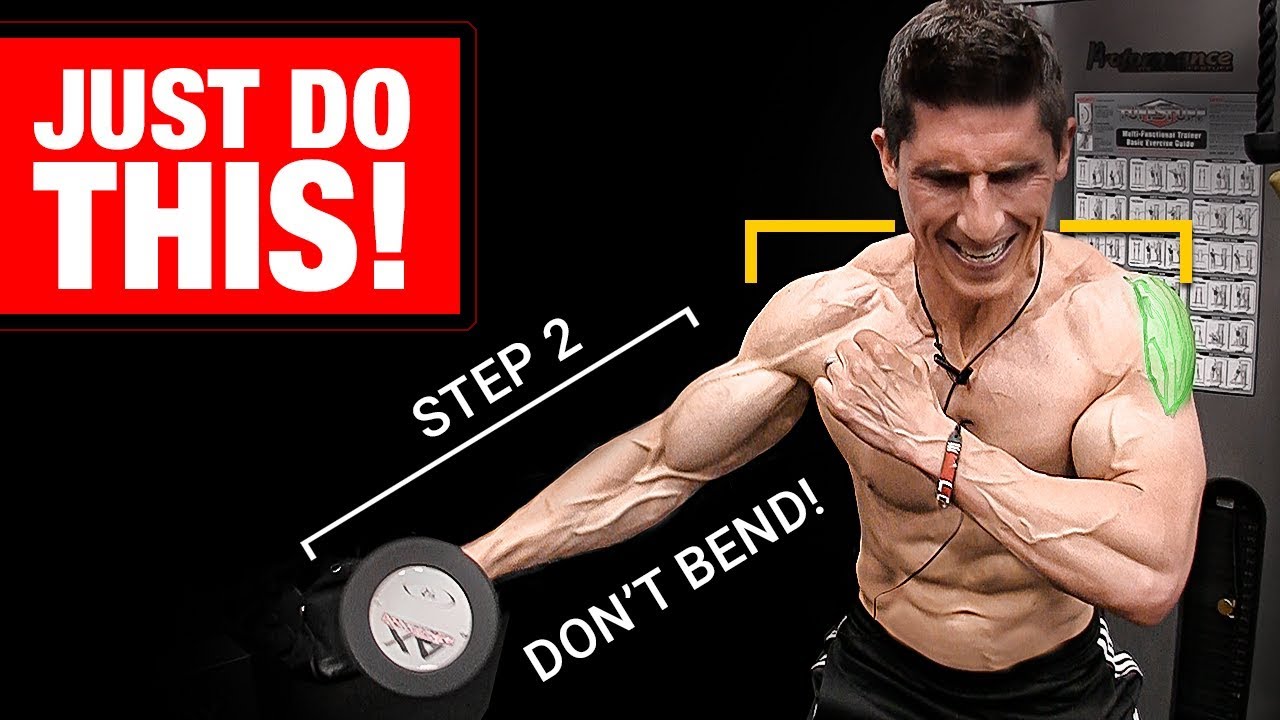

Jeff Cavaliere says the reason your shoulders won’t cap off has nothing to do with how much you’re lifting — and everything to do with how you’re lifting it.
In his ATHLEAN-X tutorial “Can’t Get Bigger, Wider Delts? Just Do THIS!!”, physical therapist and strength coach Jeff Cavaliere breaks down why so many lifters chase heavier dumbbells on side laterals and still never get that rounded, “capped” shoulder look. His fix isn’t another set of overhead presses — it’s a complete rebuild of the classic dumbbell lateral raise, stripped of momentum, swinging, and internal rotation. The goal is pure lateral deltoid activation, not ego lifting.
- Cavaliere argues heavy overhead presses build shoulder strength and power, but excessive load causes the upper trapezius and other surrounding muscles to compensate instead of the lateral deltoid doing the work.
- He instructs lifters to drop to significantly lighter dumbbells and perform controlled reps, raising the arms to shoulder height with a slight elbow bend while keeping elbow alignment strict to avoid joint impingement.
- The core principle of the video is prioritizing mind-muscle activation over resistance load to isolate the lateral head of the deltoid for hypertrophy.
Strength Versus Size in the Shoulder Complex
Cavaliere opens by drawing a hard line between what makes shoulders powerful and what makes them look bigger. Barbell and dumbbell overhead presses, he says, remain unmatched for building raw pressing strength, and there’s no exercise that replaces them for that purpose. But strength and hypertrophy are not the same training outcome, and the shoulder joint is uniquely bad at isolating itself when the load gets heavy.
Because the shoulder is surrounded by larger, more powerful muscle groups, it’s one of the easiest joints in the body to cheat. When a lifter grabs a dumbbell that’s too heavy for a strict lateral raise, the upper traps and other stabilizers take over the rep almost immediately, according to Cavaliere. That compensation pattern is exactly what blocks growth in the lateral deltoid — the muscle actually responsible for that wide, capped look most lifters are chasing.
Heavy Weight Compromises Lateral Raise Form
The dumbbell side lateral raise is, in Cavaliere’s breakdown, one of the single best movements for building the middle deltoid specifically because of the angle at which it lifts the arm away from the body. That middle-delt development is what widens the shoulders when viewed from the front. The problem is that it’s also one of the most commonly botched exercises in the gym.
Lifters routinely reach for a dumbbell heavier than what strict form can support, then compensate by swinging the weight up using momentum and body English instead of controlled deltoid contraction. Cavaliere says this pattern is the opposite of what produces hypertrophy — it shifts tension off the target muscle at the exact moment it should be under the most load.
Drop the weights way down and do exactly what I show you in this video.
The Corrected Technique
Cavaliere’s fix starts with the dumbbells themselves — he recommends grabbing a pair of 5- or 10-pound weights, far lighter than what most lifters default to on laterals. Stance matters just as much as load: a slight forward lean positions the middle deltoid directly against gravity’s downward pull. Lean too far forward and the rear delt takes over; stay too upright and the front delt starts doing the work instead.
From that stance, the elbow lifts out to the side while staying bent, with the fist pointed forward as if throwing a punch. The bent-elbow position shortens the moment arm, making it easier to actually feel the middle delt working — if there’s no significant tension at that point, Cavaliere says it’s a sign the mind-muscle connection isn’t there yet. From there, the lifter keeps tension on the delt while straightening the elbow fully, then pushes it “straighter” than feels natural to intensify the load, raises the arm another inch or two, and lowers it slowly to about 30 degrees from the body before repeating.
Lifters can cycle between the bent-elbow and straight-arm variations, Cavaliere says, as long as the focus and intent behind each rep stays locked on the middle deltoid rather than the weight on the dumbbell.
Technique Over Tonnage
The larger point of the video is one Cavaliere returns to across his catalog: it’s rarely which exercise you choose but how you execute it that determines the result. Someone grinding through heavy overhead presses and swinging lateral raises can put in the same hours as someone training with strict, lighter-weight mechanics — and come away with completely different shoulder development. Anyone comparing this kind of deliberate, technical training grind to other extreme fitness content, like the marathon effort behind WORKING OUT FOR 24 HOURS STRAIGHT!!, will notice the same theme: volume and intensity mean little without control.
Cavaliere closes the tutorial by pointing viewers toward the ATHLEAN-X Training System for a full program built around these kinds of execution details. The takeaway for anyone stuck with narrow shoulders isn’t to add another heavy set — it’s to put the dumbbells down a size and actually feel the middle delt do the work on the next lateral raise set.









The 14 People Nicki Minaj Should Be Most Afraid Of
The Tragic Real-Life Story Of Wendy Williams
2 Chainz Drinks $450K Tequila | Most Expensivest | GQ & VICELAND
Trying IMPOSSIBLE BURGER & BEST Knife Cut NOODLES!
Why Oil Paint Is So Expensive | So Expensive