

1934 Bugatti Aérolithe – Jay Leno’s Garage
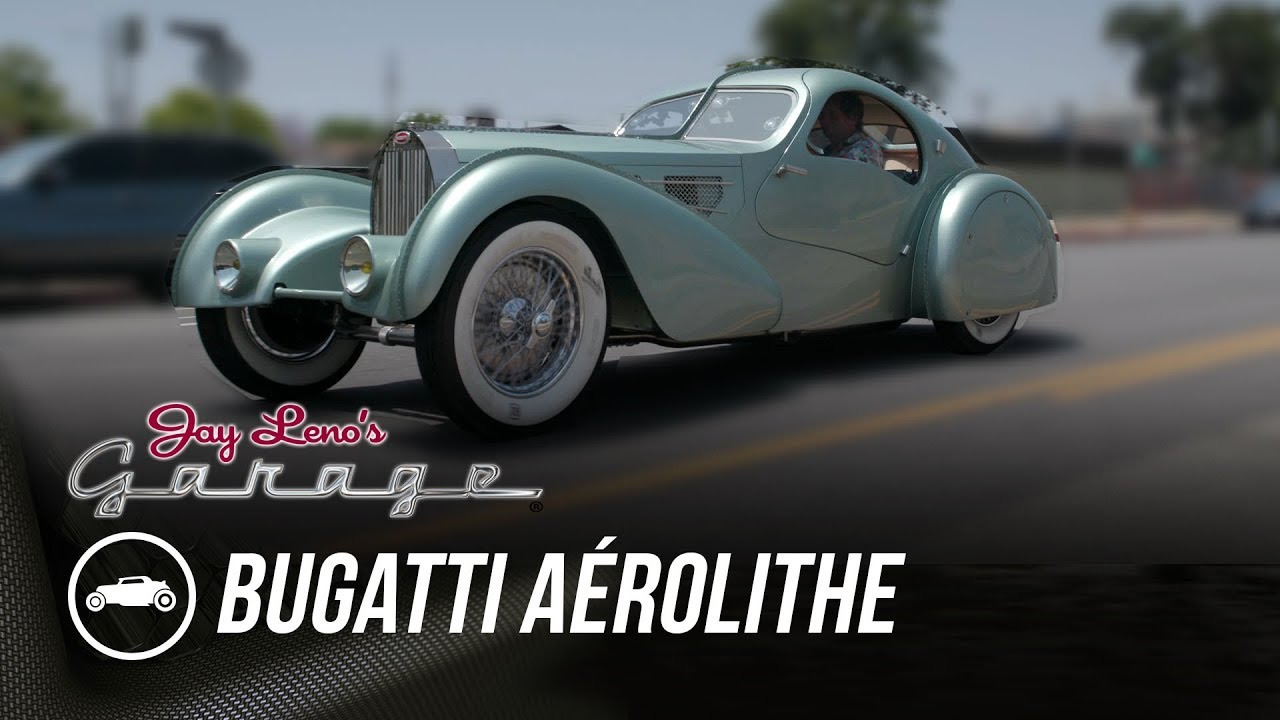

A car that vanished before World War II just got rebuilt from eleven photographs and a painting.
Jay Leno’s Garage spends this episode with a Bugatti that, technically, shouldn’t exist. The original 1934/1935 Bugatti Aérolithe disappeared decades ago, almost certainly dismantled for parts, leaving nothing behind but a handful of period photos. What Leno test-drives in this segment is a painstaking recreation built from scratch by David Grainger and his team at The Guild of Automotive Restorers in Bradford, Ontario — and it’s one of the strangest, most fragile machines to ever roll through his garage.
- The recreation was built on chassis number 57104, an original, unbodied 1934 Bugatti Type 57 chassis that still had its factory naturally aspirated engine and transmission intact.
- Grainger’s team had no blueprints to work from — only 11 period photographs, a painting, and sketches of the radiator shell and brake pedal — to reverse-engineer Jean Bugatti’s original 1935 Paris Auto Salon design.
- The body was hand-shaped out of Elektron, a magnesium alloy so brittle and flammable it can’t be conventionally welded, so the panels are joined with riveted exterior flanges exactly as the original was built.
An Investor’s Obsession With a Lost Design
The project traces back to investor Christopher Ohrstrom, who commissioned the recreation and bankrolled a build that took years to complete before the finished car was unveiled in 2013. It wasn’t a vanity showpiece for long — the Aérolithe recreation went on to win Car of the Year at the International Historic Motoring Awards, a serious nod for a car that exists only because its original was lost to history. Leno walks through that backstory with Grainger on camera, treating the car less like a hot rod and more like a recovered artifact.
Building a Car From 11 Photographs
What separates this build from a typical restoration is that there was nothing left to restore. Grainger’s team had to reconstruct Jean Bugatti’s design language using only a handful of black-and-white photos, a painting, and rough sketches of two components — the radiator shell and the brake pedal. Everything else, from panel curvature to proportion, had to be derived by studying those images and cross-referencing them against the surviving Type 57 chassis underneath.
Eleven photographs and a painting were all Grainger’s team had to reverse-engineer a car that vanished before World War II.
Elektron Manufacturing Presents Significant Hazards
Historical accuracy meant using the same material Bugatti used in the 1930s: Elektron, a magnesium alloy prized for being extremely lightweight but notorious for being brittle and flammable. Because it can’t be conventionally welded, the body panels had to be joined the way the original was — flanges riveted together rather than fused — a slower, more labor-intensive process that mirrors exactly how Jean Bugatti’s original coupe was assembled before it disappeared. Grainger walks Leno through the metal-shaping and engineering hurdles that came with recreating that process from scratch, panel by panel.
Putting First Miles on a Historic Recreation
After the walkthrough, Leno does what he does best — he takes the car out on the road, putting some of its very first driving miles on the odometer. For a vehicle built around a magnesium body that can’t tolerate ordinary repair welding, that drive is as much a stress test of Grainger’s craftsmanship as it is a joyride, and it’s the payoff of the whole segment on Jay Leno’s Garage.
If you want to see the Aérolithe in person rather than just on Leno’s YouTube channel, the recreation is scheduled to appear at the Atlanta Concours d’Elegance on October 19th and 20th, 2019 — a chance to get a close look at rivet lines and body panels that took a small Ontario shop years to get right.









The Real Reason Chelsy Davy and Prince Harry Broke Up
10 Things Fashion Retailers DON’T Want You To Know
iOS 13 Beta 5! 150+ New Features & Changes
The Shady Truth About Paulina Gretzky’s Fiance
THE TEAM ALBOE CHALLENGER GAMES – $10,000 RACE!!