

 InfoSearched
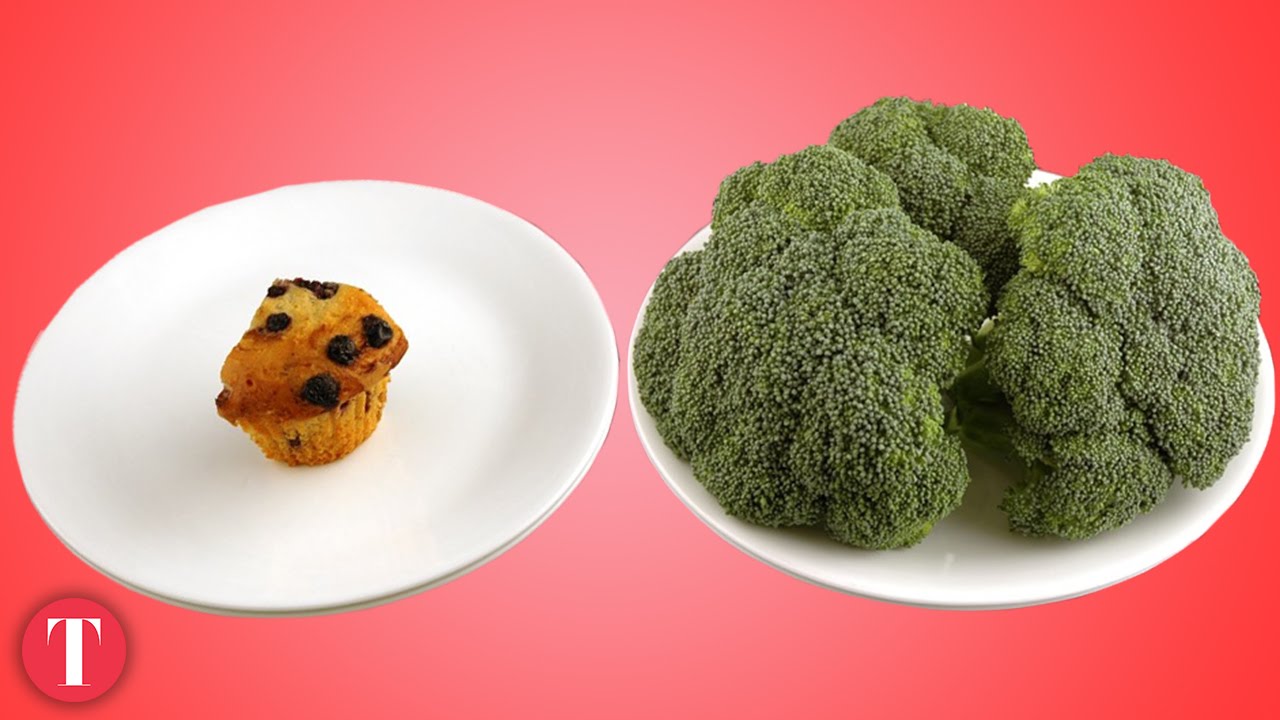
Two plates, same 200 calories, completely different amount of food on them.
A viral breakdown called “This Is What 200 Calories Look Like: Junk vs. Healthy Food” lines up equal-calorie portions of processed snacks against whole foods and lets the plates do the talking. The video builds on a visual-nutrition concept that outlets including The Guardian popularized back in 2013, when photographers first laid out 200-calorie servings side by side to show how wildly portion size swings depending on what’s on the plate.
The math is simple, but the visual gap is the whole point. Foods loaded with water and fiber take up enormous space to hit 200 calories, while foods built on refined sugar, fat, and oil hit that same number in a fraction of the volume. Nobody eating a heap of broccoli is walking away hungry the way they might after a handful of chips.
- It takes roughly 1,425 grams of celery, 588 grams of broccoli, 570 grams of baby carrots, or 385 grams of apples — several whole apples — to reach 200 calories.
- By contrast, 200 calories is just 23 grams of canola oil, 28 grams of butter, 34 grams of peanut butter, 37 grams of potato chips, or 41 grams of a Snickers bar or Doritos.
- For fast food and drinks, 200 calories is barely half a small hot dog or burger, 73 grams of French fries, or about 496 ml of regular Coca-Cola.
Numerical Perception Varies Across Contexts
The reason a pile of celery dwarfs a tablespoon of canola oil at the same calorie count comes down to energy density — how many calories are packed into each gram of food. Water and fiber add bulk without adding calories, which is why vegetables and fruit need huge portions to reach 200 calories. Oils, butter, and candy work the opposite way: almost pure fat or sugar, concentrated and calorie-heavy, so a small amount goes a long way on the calorie counter even though it barely covers a plate.
That’s why 50 grams of candy — about 17 gummy bears — carries the same caloric load as nearly two-thirds of a kilogram of celery. The body registers the same 200 calories either way, but only one of those options leaves you full.
The Junk Food Side of the Plate
The video’s junk food comparisons are where the numbers get uncomfortable. A Snickers bar or a serving of Doritos both cap out around 41 grams for 200 calories — a few bites, gone. Potato chips aren’t far behind at 37 grams, and butter and peanut butter, at 28 and 34 grams respectively, disappear even faster once you account for how thin those portions actually look on a plate.
Fast food fares no better. Half a small hot dog or half a small burger already burns through 200 calories, and a large Coca-Cola bottle’s worth — 496 ml — does the same without a single bite of solid food involved. Seventy-three grams of French fries, roughly a small handful, rounds out the same category.
200 calories of celery fills a bowl. 200 calories of canola oil barely covers a tablespoon.
The Case for Volume Eating
The underlying principle the video is demonstrating is what nutritionists call volume eating: choosing foods that deliver bulk and fiber for fewer calories, so the stomach feels full before the calorie count climbs. Celery at 1,425 grams for 200 calories, broccoli at 588 grams, and baby carrots at 570 grams are the extreme end of that spectrum — foods you’d struggle to overeat even if you tried.
Apples split the difference. At 385 grams for 200 calories, that’s several whole apples, enough fiber and chewing time to make satiety a lot easier to hit than with a candy bar that vanishes in three bites.
Evidence Provided By Comparative Analysis
None of this argues that 200 calories of Doritos is inherently more dangerous than 200 calories of broccoli in a strict calorie-counting sense — a calorie is a calorie on a metabolic level. What the visual comparison nails down is portion psychology: the body’s hunger signals respond to volume and fiber as much as to raw calorie totals, and a diet built on celery, carrots, and apples is going to leave someone fuller than one built on chips, candy, and soda, even at matching calorie counts.
That’s the same reasoning behind other viral challenge-style content that’s tested physical limits for the camera — think the marathon push of a 24-hour workout stretch or the sheer scale ambition behind a world’s-largest-anything stunt. Different subject, same appeal: showing rather than telling how big a number actually is once you see it laid out in front of you.









Yo Gotti – Cold Gangsta (Official Music Video) ft. 42 Dugg, EST Gee
10 Disney Princesses Reimagined As ANIME Characters
10 Most Amazing Women In The World
Celebs Who Made Fools Of Themselves At Awards Shows
Diane Guerrero, Stephanie Beatriz – What Else Can I Do? (From “Encanto”)