

4 Parasites Too Creepy to Exist

Somewhere in the rainforest right now, a worm is crossing someone’s eyeball.
SciShow host Hank Green opens his August 2019 episode “4 Parasites Too Creepy to Exist” with a number that reframes the whole idea of biodiversity: somewhere between one-third and one-half of every species on Earth survives by living off another organism. The video, also circulated under the title “The 4 Creepiest Parasites on Earth (This Will Keep You Up at Night!),” runs through four case studies that make the math feel a lot more personal than a textbook statistic.
- SciShow frames the entire episode around the claim that parasitic species make up roughly one-third to one-half of all life on Earth.
- Loa loa, the African eye worm, spreads through deerfly and mango fly (Chrysops) bites and grows into adult worms several centimeters long that migrate under the skin and across the conjunctiva of the eye.
- Dracunculus medinensis, the Guinea worm, is picked up from stagnant water containing infected copepods, and roughly a year later a female worm up to a meter long erupts through the skin of the leg to release her larvae.
The Premise Behind the List
Green doesn’t build the episode around gross-out shock value for its own sake — he builds it around scale. If parasitism really accounts for a third to a half of all species, then the four organisms profiled aren’t outliers; they’re a sampling of one of the most successful survival strategies biology has ever produced. That framing is what separates the segment from a typical “world’s weirdest creatures” reel and gives the rest of the video its stakes.
This kind of stomach-turning, high-concept science content has become its own lane on YouTube, sitting alongside physical-extreme programming like the world’s most dangerous escape room stunts and endurance-based spectacles such as the world’s largest challenge videos — content built to make viewers squirm while they keep watching.
The African Eye Worm
Loa loa is endemic to the rainforest belt of West and Central Africa, where it’s transmitted through the bite of deerflies and mango flies — insects in the Chrysops genus. Once the larvae get into subcutaneous tissue, they mature into adult worms that can stretch several centimeters and spend their adult lives migrating just beneath the skin.
The part that makes this one a horror-movie staple is the eye. The worms regularly cross into the conjunctiva, where they become visibly, squirmingly present in the corner of a host’s vision. Alongside the ocular migration, patients experience intense itching, irritation, and Calabar swellings — transient, localized swelling that flares up wherever the worm happens to be passing through.
The Guinea Worm’s Year-Long Migration
Dracunculus medinensis takes a slower, more deliberate route to misery. Infection starts with drinking stagnant water contaminated with microscopic copepods — water fleas — carrying Guinea worm larvae. The body digests the copepods, freeing the larvae, which then mate deep in the host’s connective tissue.
Roughly a year passes before the payoff. The mature female, by then up to a meter long, migrates toward the lower limbs and produces a painful, blistering lesion. That lesion burns badly enough that hosts instinctively plunge the affected limb into water for relief — which is exactly what the worm is counting on, since contact with water triggers her to burst through the skin and release hundreds of thousands of larvae straight back into the water supply, restarting the cycle.
A worm up to a meter long spends a year growing inside a human leg before bursting out through the skin to seed the next generation in the water supply.
Rounding Out the List
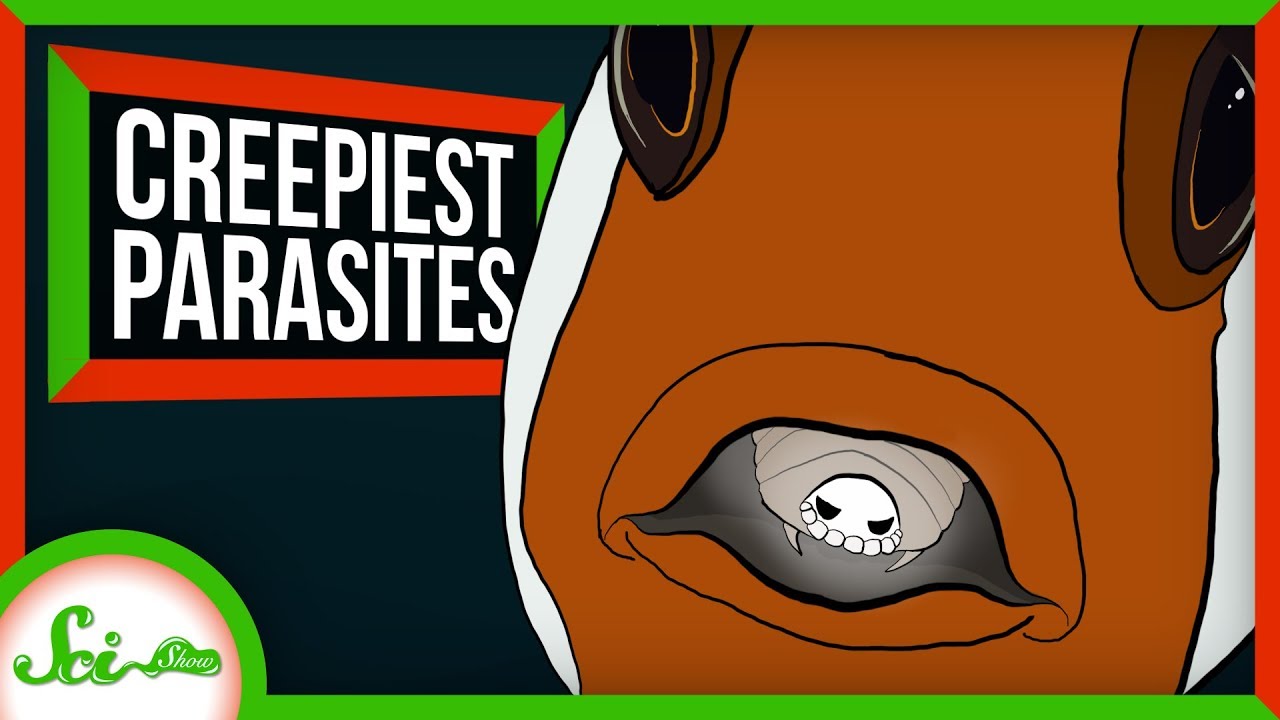
The episode also runs through the brain-eating amoeba, Naegleria fowleri, a freshwater organism that enters through the nose and can trigger a rare, usually fatal brain infection called primary amoebic meningoencephalitis, with risk spiking during warm-water summer months. Green closes the countdown with Cymothoa exigua, the tongue-eating louse, a parasitic crustacean that lodges in a fish’s mouth, severs the blood supply to the tongue until it withers away, and then attaches itself in the tongue’s place, feeding off the host for the rest of its life.
SciShow closes the segment the same way it opens — by circling back to that one-third-to-one-half statistic, a reminder that everything above, the eye worm crossing a cornea, the foot-long worm blistering out of an ankle, is standard operating procedure for a huge chunk of life on Earth, not the exception.









Celebs Who Identify As Non-Binary
The Untold Truth Of Hermione Granger
What You Didn’t Know About Mike Pence’s Kids
Actors Hollywood Dumped After One Hit Role
The Truth About Clint Eastwood’s Longtime GF Who Died In 2018