

1000 CANS OF COKE vs STEAM ROLLER!! (COCA COLA vs ROAD ROLLER EXPERIMENT)
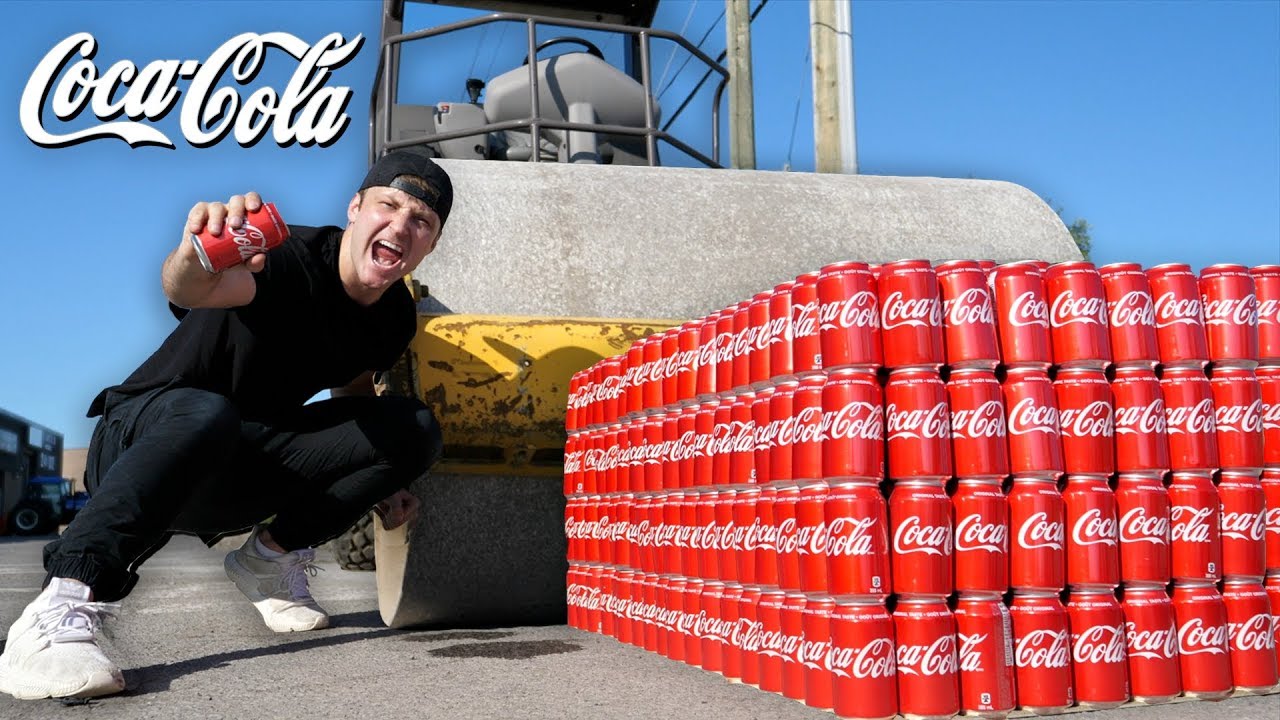

A thousand full cans of Coke line up against several tons of steel, and it’s over before it starts.
JustDustin’s backyard destruction channel built its name on exactly this kind of setup: take something ordinary, multiply it by a thousand, and run heavy machinery over it to see what happens. In “Can 1,000 Cans Of Coke Stop A Steam Roller??”, Dustin and his crew line up roughly 1,000 unopened aluminum cans of Coca-Cola in tight rows across pavement and send a road roller straight through them.
- Dustin and his crew arrange approximately 1,000 full, unopened Coca-Cola cans in tight rows across a paved surface before the roller run.
- The steel drum of the road roller crushes the cans instantly on contact, with no interruption to its pass.
- The impact triggers explosive bursts of carbonated soda, sending plumes and jets of Coke across the area and leaving flattened aluminum sheets in its wake.
The Setup
The premise is simple and stated right in the title: can sheer volume — a thousand cans, packed edge to edge — do anything to slow down a piece of industrial equipment built to compact asphalt? Dustin’s crew doesn’t stack the cans or reinforce them; they’re laid out flat and full, exactly as they’d come off a store shelf, forming a dense grid meant to give the roller’s drum as much surface area to chew through as possible.
This is standard territory for the channel — outsized, is-it-possible stunts that trade on scale rather than subtlety. The appeal is the same one that’s driven other viral crush-and-destroy content: viewers already know the likely outcome, but watching the actual moment of impact is the draw.
The Roller Makes Its Pass
Once the roller starts forward, there’s no hesitation, no stall, no resistance from the cans whatsoever. The drum simply rolls over the grid, and the combined weight and pressure pop every can in its path almost simultaneously. Soda erupts outward and upward in sheets and jets as the aluminum gives way instantly under the load.
The cans don’t slow the roller for even a second — they just explode.
What’s left behind is exactly what you’d expect from a thousand crushed cans: flattened aluminum sheets pressed into the pavement and a spreading, foaming spill of Coke covering the surface. There’s no partial resistance or gradual give — the transition from full can to flattened metal happens in the instant the drum passes over.
Outcome Was Never in Doubt
Aluminum cans are built to hold pressurized liquid, not to bear crushing loads from above. A road roller’s drum concentrates the machine’s full weight into a narrow line of contact, which is precisely the kind of force soda cans have zero engineering to resist. The result: total, immediate structural failure, and the visual payoff of soda spraying everywhere as each row gets flattened in sequence.
It’s the same setup logic that fuels other oversized challenge videos in this space, from record-length props to giant-scale physical stunts — take a familiar object, blow up the quantity, and let heavy machinery or brute force settle the question in seconds. Readers who enjoy that genre of scale-driven stunt content might also recognize the format from pieces like World’s Largest Challenge! or World’s Most Dangerous Escape Room!, both built around the same “can this even work” premise before the payoff hits.
The roller doesn’t even slow its pace crossing the grid — one continuous pass, a thousand cans down, soda everywhere. That’s the whole video, and that’s exactly why it worked as well as it did for JustDustin’s audience.









My 600-lb Life Patients Who Completely Transformed Themselves
13 Celebs Who Had Babies When They Were Really Young
Cleopatra’s Little Sister vs. The World (feat. Aubrey Plaza and David Wain) – Drunk History
Fake Beauty – Celebrity Photoshop Fails
The Most Outrageous Confessions On Howard Stern