

 InfoSearched
Disney’s most beloved cartoon faces started out as real people standing in a rehearsal room, mugging for a camera.
Long before motion capture and CGI, Disney animators solved the same problem the studio has wrestled with since the 1930s: how do you make a drawing move like a person? The answer, repeatedly, was to hire an actual person, film them, and trace the performance. Some of the results are hiding in plain sight in movies fans have watched a hundred times.
- Dancer Marge Champion was the primary physical reference for Snow White in 1937, then returned as the live-action model for the Blue Fairy in “Pinocchio” (1940) and Hyacinth Hippo in “Fantasia” (1940).
- Eleanor Audley voiced and physically acted out both Lady Tremaine in “Cinderella” (1950) and Maleficent in “Sleeping Beauty” (1959), headdress and all.
- Ursula the Sea Witch in “The Little Mermaid” (1989) was built around drag icon Divine, while Aladdin himself got redesigned around Tom Cruise’s features and swagger for the 1992 film.
Marge Champion’s Football Helmet
To get Snow White’s exaggerated proportions right, animators needed a live body to study, not just an actress’s face. Marge Champion, then billed as Marge Belcher, danced entire sequences in full costume while wearing an oversized football helmet, standing in for Snow White’s cartoonishly large head so the animation crew could track her motion frame by frame. Disney liked what it saw enough to bring her back twice, first as the reference model for the Blue Fairy in “Pinocchio” and again as Hyacinth Hippo, the tutu-clad hippopotamus dancer in “Fantasia’s” “Dance of the Hours” sequence.
Champion wasn’t the only Golden Age performer asked to act absurd for the sake of realism. Margaret Kerry posed with oversized props standing in for Tinker Bell’s fairy-sized world, giving animators a physical sense of scale long before anyone said the words “motion capture.”
One Actress, Two of Disney’s Most Feared Villains
Eleanor Audley pulled off one of the stranger double assignments in studio history. Animators Frank Thomas and Marc Davis had her voice Lady Tremaine in “Cinderella” and then, nine years later, voice Maleficent in “Sleeping Beauty” — but Audley didn’t stop at voicing either role. She acted out both characters in costume, including Maleficent’s towering horned headdress, and the animators drew directly off her sneers, her posture, and her imperious walk to shape the villains’ faces.
Helen Kane sued the makers of Betty Boop over what she called a “deliberate caricature” of herself — and lost.
Borrowing From Celebrities Instead of Reference Models
Not every likeness required a studio session. Sometimes Disney simply reached for a famous face. Ursula in “The Little Mermaid” was explicitly designed after drag performer Divine, real name Harris Glenn Milstead, right down to the dramatic makeup and theatrical body language. When “Aladdin” went into production in 1992, animators redesigned the title character around Tom Cruise’s features and swagger, while the Genie was voiced by, and visually inspired by, Robin Williams’s manic delivery. Even the vultures in 1967’s “The Jungle Book” got the celebrity treatment, modeled after The Beatles.
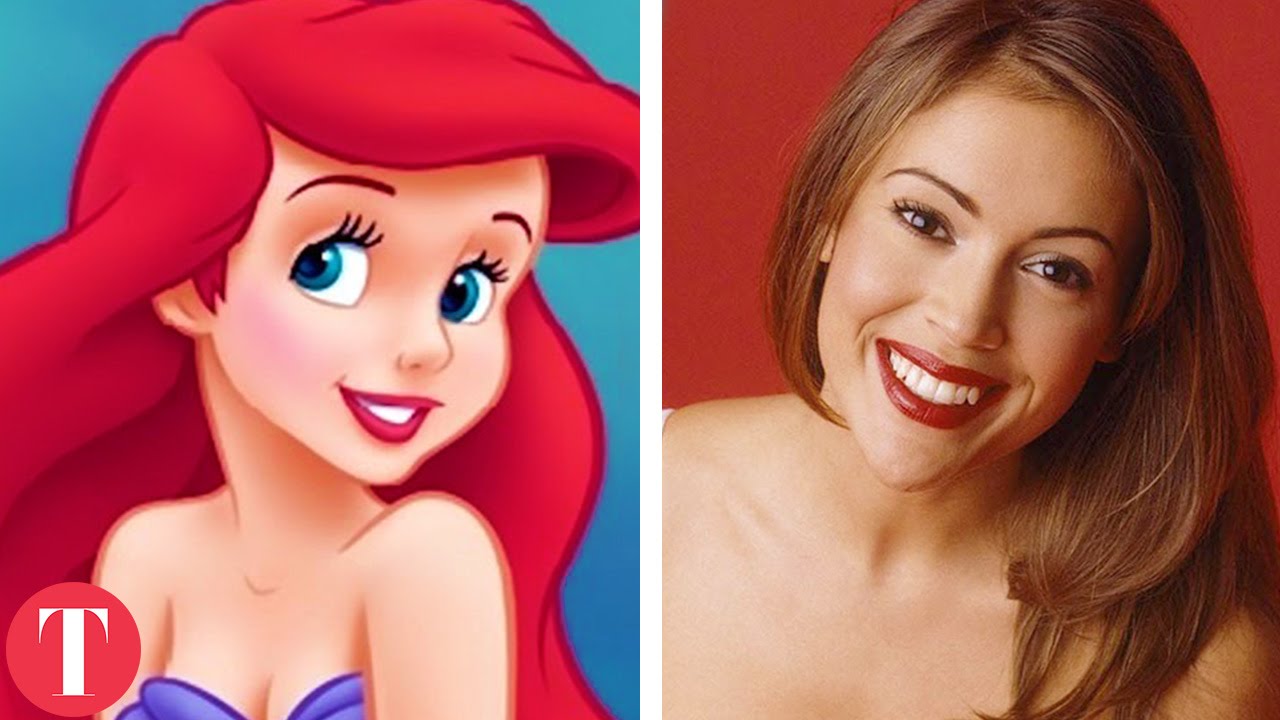
The Little Mermaid’s Ariel had her own split-duty origin story: her face drew on child actress Alyssa Milano from “Who’s the Boss,” while her actual movements came from producer and writer Sherri Stoner, who swam in a tank of water to give animators something to trace. Stoner later got to stay dry when she modeled Belle’s movements for “Beauty and the Beast.”
The Double-Duty Performers
Kathryn Beaumont holds a rare distinction at the studio: she provided both the voice and the live-action physical performance for two separate heroines a generation apart on screen, Alice in “Alice in Wonderland” (1951) and Wendy Darling in “Peter Pan” (1953). Watching either film with that in mind, the resemblance in expression and cadence between the two characters is hard to miss — it’s essentially the same performer’s instincts filtered through two different pencils. Fans who enjoy spotting uncanny real-world matches might get a kick out of celebrity doppelgängers who look freakishly alike, since Disney’s animation department was essentially running the same exercise decades before social media made it a game.
The Consequences of Digital Likeness
Not every real-life connection ended amicably. Harley Quinn, later adopted into the wider DC animated universe, was inspired by writer Paul Dini’s college friend Arleen Sorkin — a friendly borrowing. But singer Helen Kane wasn’t nearly as pleased when she recognized herself in Betty Boop’s exaggerated baby-doll look and voice; she filed an infringement lawsuit accusing the character’s creators of a “deliberate caricature” of her persona. She lost the case, and the ruling became one of the early legal markers for how much protection a performer’s look and mannerisms actually get once an animation studio gets its hands on them. Disney’s own animation techniques carry that same DNA forward today, whether it’s Diane Guerrero and Stephanie Beatriz voicing “Encanto” or any modern film still leaning on a real performer’s face and rhythm to sell a drawing as alive, as seen in the studio’s ongoing work like “What Else Can I Do?” from Encanto.

Sam Smith, Normani – Dancing With A Stranger
10 Famous Child Stars Who Became INCREDIBLE Actors
10 wings | 5 minutes!!! IMPOSSIBLE Food Challenges in the USA! (worst day of my life)
10 Disney Inspired Makeup Products You Can Buy RIGHT NOW
As Seen On TV Plumbing Gadgets… Do they work?