

 InfoSearched
Ten of pop music’s most famous album covers get a very different look once they cross into Saudi Arabia.
TheThings Celebrity’s video “10 Alternate Music Covers For Middle East Censorship” walks through a phenomenon that’s been documented for years and got fresh attention after Business Insider’s June 2017 roundup: Western pop albums sold in conservative Gulf markets don’t arrive with the same artwork fans see on iTunes or in a U.S. record store. Retailers and distributors quietly redraw, black-bar, or crop the covers so they clear local decency laws before a single CD reaches a shelf. The results range from clumsy to genuinely inventive, and the video runs through ten of the most-cited examples.
- Saudi Arabia’s Committee for the Promotion of Virtue and the Prevention of Vice enforces the modesty standards that force labels to alter cover art before it can be sold.
- Shakira’s “Oral Fixation Vol. 2” cover, originally a nude Garden-of-Eden-style pose, gets extra foliage added to cover her torso and lower body for regional release.
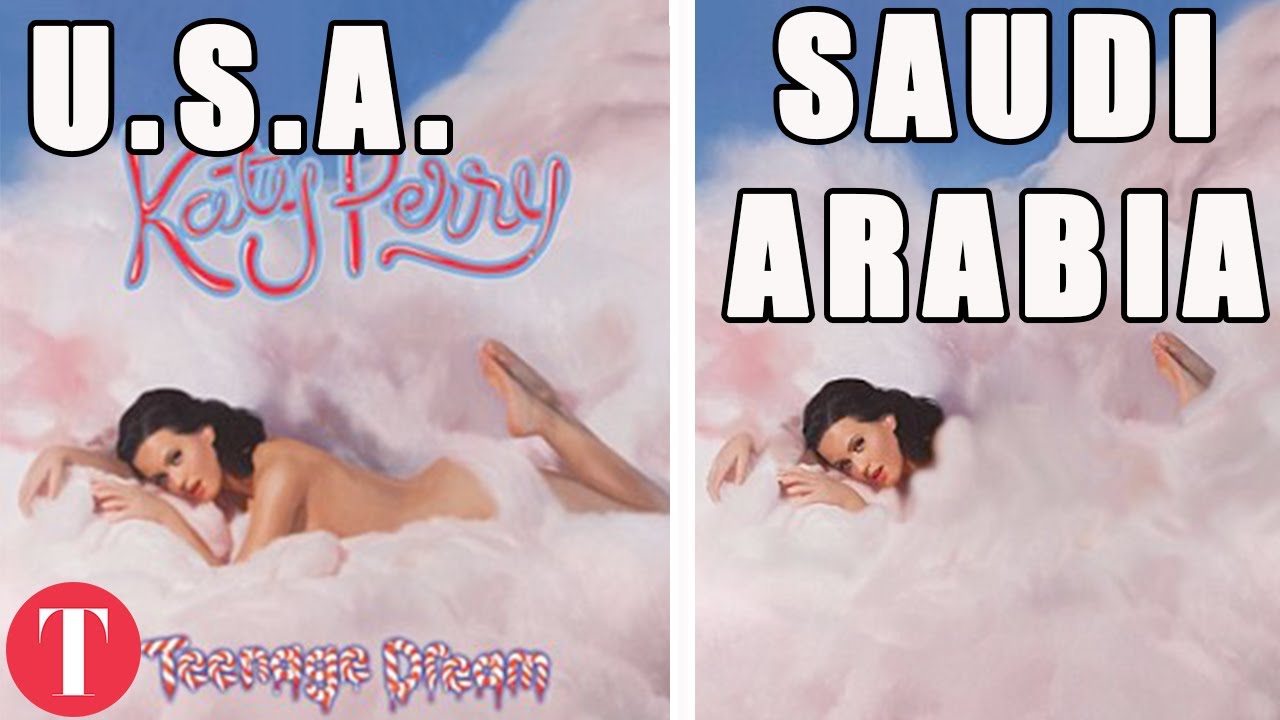
- Britney Spears’s “…Baby One More Time” and “In the Zone,” along with Christina Aguilera’s “Stripped” and “Lotus,” Mariah Carey’s “Butterfly” and “#1’s,” Katy Perry’s “One of the Boys” and “Teenage Dream,” and Lady Gaga’s “The Fame Monster” and “Artpop” are all reworked with digital clothing, expanded flowers, dark overlays, or cropping.
Mechanisms of Modern Digital Censorship
The process isn’t subtle. Cleavage, bare shoulders, midriffs, and legs on prominent female pop artists get painted over with crude Photoshop additions — dark panels, digitally drawn shirts, or opaque garments stitched onto the original image. When there’s too much skin for a patch job to fix, editors simply crop the figure out of frame or blur it into an unrecognizable smear. Every fix serves one purpose: getting an import past the shelf inspection so the CD can legally sit in a store in Riyadh or Jeddah.
Shakira’s case is the one that keeps circulating because the fix is almost artistic. Her original “Oral Fixation Vol. 2” cover depicts her nude in a garden-of-Eden pose; the Gulf version buries her in so much added foliage that the censorship itself becomes the image’s defining feature. Britney Spears gets a similar treatment on both “…Baby One More Time” and “In the Zone,” where exposed midriffs and skirts are filled in with drawn-on shirts or blacked-out sections rather than redesigned outright.
The Pattern Across Pop’s Biggest Names
Christina Aguilera’s covers follow the same playbook twice over. “Stripped” and “Lotus” both feature suggestive or nude poses that get masked by oversized flower graphics or darkened overlays large enough to swallow the original composition. Mariah Carey’s “Butterfly” and “#1’s” lose exposed legs and shoulders under digitally added dresses, or simply get cropped tight enough that the offending skin disappears from frame entirely.
Katy Perry doesn’t escape it either — “One of the Boys” and “Teenage Dream” both get cropped or fitted with virtual tops to cover cleavage and reclining poses. Lady Gaga’s “Artpop” and “The Fame Monster” round out the list with bare skin digitally clothed rather than removed, since her covers tend to be busy enough that a patch blends in more easily than a crop would.
Shakira’s nude Garden-of-Eden pose survives the censors only by disappearing behind enough foliage to cover her torso and legs entirely.
Motivations Behind Corporate Labeling Efforts
None of this is optional if a label wants physical distribution in the region. Saudi Arabia’s modesty and public-decency statutes, enforced on the ground by the Mutaween, give retailers no room to sell an uncensored cover — the choice is alter it or don’t stock it. Altering the artwork lets international labels keep selling CDs in a market they’d otherwise lose entirely, which is exactly why pop’s biggest sellers keep showing up on these censored-cover lists rather than smaller acts nobody imports in bulk.
It’s the same tension that runs through a lot of pop stardom’s carefully managed public image — the version fans see in one market isn’t always the version another market gets, whether that’s a lip-synced awards show set or an album cover with a garden’s worth of extra leaves painted on. TheThings’ rundown just happens to put the visual proof side by side.
The list has stuck around online precisely because the Shakira cover is so recognizable in its original form — most fans who’ve seen the “Oral Fixation Vol. 2” artwork have no idea the Gulf version exists until someone puts the two side by side, which is exactly what keeps videos like this one getting reshared years after the covers themselves came out.







YouTube Stars Who Ruined Their Career With A Single Video
The Most Cringeworthy Live! Moments Ever
8 Optical Illusions That Will Trick Your Mind
10 Things Guys Do That Girls Like
Brad and Claire Make Doughnuts Part 1 | It’s Alive | Bon Appétit